
Grievance App: The Ultimate Custom GRM Solution for Unique Organizational Needs
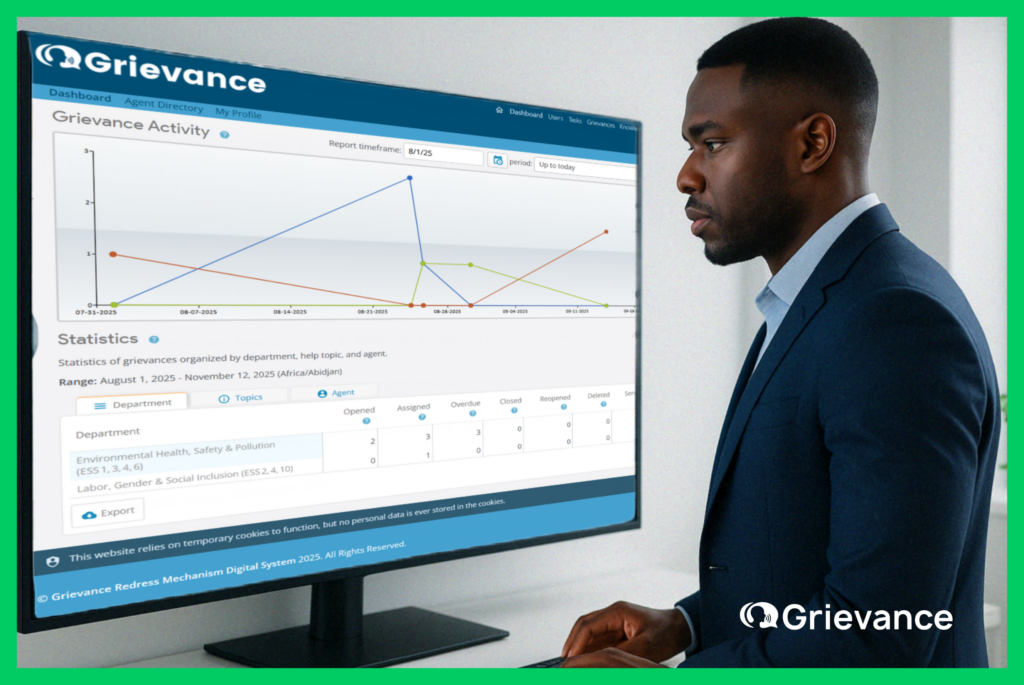
Every organization, from government ministries to international NGOs, faces unique challenges when handling complaints and feedback. A one-size-fits-all approach to grievance redress often falls short. Stakeholders demand that their concerns be heard and resolved in a way that fits the project context. This is where a custom GRM solution comes into play. By implementing a tailored Grievance Redress Mechanism (GRM) with flexibility at its core, organizations can ensure no complaint slips through the cracks.
Grievance App is an innovative digital platform designed to adapt to these diverse needs, acting as a turnkey solution to collect, track, and resolve grievances efficiently. It transforms traditional complaint handling, which is often slow and opaque, into a transparent, responsive process that builds trust. In this article, we’ll explore how Grievance App can be customized for various types of organizations, ensuring each entity’s unique requirements are met while upholding global best practices in accountability and transparency.
One Size Doesn’t Fit All: Why Customize Your GRM?
Grievance mechanisms are essential for accountability, but each organization operates in a different context. Regulations, stakeholder expectations, and project scopes vary widely between a government infrastructure project and a humanitarian NGO program. A custom GRM solution is therefore not a luxury; it’s a necessity to address these differences. In fact, major development institutions now mandate robust grievance systems in projects as a condition of funding. For example, the World Bank’s ESS10 standard explicitly requires an “accessible and inclusive” grievance mechanism for stakeholders. Failing to tailor your GRM to meet such standards (and the cultural context of your stakeholders) can lead to unresolved complaints, eroded trust, or even project delays.
To highlight the need for customization, consider the following common factors that a flexible GRM must accommodate:
- Language & Accessibility: Organizations may operate in multilingual environments or remote areas. A custom solution supports multiple languages and channels (web, mobile, SMS) to ensure every stakeholder can submit a complaint.
- Regulatory Compliance: Different sectors and funders impose various requirements. A tailored GRM aligns with laws and standards, from data privacy (GDPR) to donor policies, so that the process is always compliant.
- Workflow & Escalation: The urgency and routing of grievances might differ. Custom rules (e.g., automatic escalation if unresolved in 7 days) and role-based access can be configured to match an organization’s internal process.
- Integration with Systems: Many organizations want their grievance data connected to existing tools (e.g., project management software or CRM). A flexible platform offers API integration to fit into your IT ecosystem.
- Scale & Scope: A local NGO’s GRM might handle dozens of complaints, while a national government’s could handle thousands. Customization ensures that the system’s dashboards, categorization, and analytics are tailored to the project’s scale.
Grievance App was built with these needs in mind. Digitizing and customizing the grievance process enables an organization to create a mechanism that feels tailored specifically to its context. As we’ll see below, this adaptability benefits governments, NGOs, international donors, and private sector organizations alike.
Custom GRM Solution for Government & Public Sector Projects
Government agencies and public sector institutions often deal with large-scale projects (infrastructure, public services, etc.) that affect diverse populations. They require grievance systems that are transparent, inclusive, and compliant with public accountability standards. Grievance App can be configured as a custom GRM solution for government needs, ensuring citizen complaints are handled efficiently and according to policy.
For example, a government ministry implementing a nationwide infrastructure project can use Grievance App to set up a branded, multilingual complaints portal. The interface can carry the agency’s logos and colors, and forms can be customized to collect data relevant to regulatory requirements (e.g., environmental or land acquisition issues). This platform isn’t rigid; administrators can configure categories of grievances (land, compensation, safety, etc.), define priority levels, and assign each complaint to the appropriate department automatically.
Grievance App’s flexibility for government use cases includes:
- Branded Public Portal: Adapt the interface with official branding and instructions, so citizens recognize it as an authoritative channel for grievances. You can customize forms and fields to capture exactly the information required for public-sector reports.
- Multi-Lingual Support: Serve all constituents by offering complaint submission in multiple languages (national or local). Whether a citizen speaks English, French, or a local dialect, the platform is accessible in their language for greater inclusion.
- Workflow Alignment with Policy: Define workflows that align with government protocols. For instance, set automatic escalation to higher authorities if a complaint isn’t resolved by a department within a set timeframe (ensuring compliance with service charters or SLA commitments).
- Integration with Government Systems: Easily connect the GRM with existing government hotlines or case management systems via API. This means a complaint lodged through a call center or an e-government portal can automatically appear in Grievance App for tracking.
- Auditability & Compliance: Every action on a case is timestamped and logged, creating an auditable trail. This is crucial for public accountability, enabling oversight bodies or auditors to verify that complaints were handled in accordance with laws and World Bank or donor standards.
By customizing these features, governments can handle complaints in a unified, transparent manner that strengthens public trust. Instead of scattered paper forms or siloed hotlines, officials get a real-time dashboard of all grievances. This improves responsiveness (citizens can track the status of their complaints online) and ensures no concern goes unheard, reinforcing the credibility of public institutions.
Tailoring Grievance Redress Mechanisms for NGOs & Humanitarian Organizations
Non-governmental organizations (NGOs), nonprofits, and humanitarian agencies operate in environments where community trust and participation are paramount. These organizations often work closely with vulnerable populations and must handle sensitive complaints (e.g., about aid distribution, safeguarding issues, or project impacts on communities). A Grievance Redress Mechanism for an NGO needs to be accessible, safe, and community-friendly. Grievance App addresses this by letting NGOs tailor the platform to their grassroots context.
Key ways an NGO or humanitarian actor can customize Grievance App include:
- Anonymous & Safe Reporting: Encourage reporting by allowing anonymous submissions. Whistleblowers or community members fearful of retaliation can lodge complaints without revealing their identity, increasing trust and uptake.
- Community Languages: Customize the language options to include local languages or dialects spoken in the project area. An international NGO can set up the GRM to accept complaints in, say, French, Arabic, and local African dialects, ensuring marginalized voices are heard in their mother tongue.
- Multi-Channel Intake: Not all communities have consistent internet access. Grievance App supports multiple channels (a web form, mobile app, SMS, or even offline data entry by field staff). This multichannel design allows an NGO to capture complaints from a remote village via SMS or from a community meeting via a tablet, all into one central system.
- Issue Category Customization: Define categories and tags that make sense for your programs. For instance, a humanitarian organization might categorize grievances as “Food Distribution,” “Water & Sanitation,” “Staff Conduct,” etc., to streamline routing and analysis.
- Collaborative Case Management: NGOs can enable role-based access for different team members, field officers, project managers, and M&E specialists, to collaborate on resolving issues. Everyone sees updates in real time, which is critical in emergencies or fast-moving project environments.
Crucially, NGOs can leverage Grievance App’s inclusive design. The platform’s multilingual and anonymous submission options ensure that even marginalized voices can be heard without fear. By lowering barriers to reporting, NGOs often find that community feedback increases, providing valuable insights that help improve programs.
In humanitarian projects, catching a grievance early (for example, about unfair aid distribution) allows the team to address the issue before it escalates into a loss of community trust. A custom-tailored GRM thus becomes an empowering tool for communities: it shows that the NGO is listening and committed to accountability. This not only resolves individual complaints but also strengthens the NGO’s relationship with the community and donors.
Meeting Donor & International Agency Requirements with a Custom GRM Solution
International development agencies and donors (such as the World Bank, African Development Bank, UN agencies, EU, etc.) increasingly expect projects to implement formal grievance mechanisms for stakeholders. These institutions have specific standards, for example, the World Bank’s Environmental and Social Framework (especially ESS10) and the UN Guiding Principles on Business and Human Rights, which outline how a GRM should function. Grievance App can be configured to ensure full compliance with these international standards, essentially providing a custom GRM solution that satisfies donor requirements out of the box.
Here’s how Grievance App supports development banks and international partners:
- Built-in Compliance Features: The platform’s design aligns with globally recognized criteria (timeliness, transparency, accessibility, etc.). It automatically logs each complaint with a unique ID and audit trail, meeting the transparency and record-keeping expectations of donors. For instance, if ESS10 requires an “accessible and inclusive” mechanism, Grievance App’s multi-channel, multi-language intake fulfills that mandate. Likewise, automated escalation rules and reminders ensure predictable and timely resolutions, as demanded by standards like UNGP 31.
- Reporting & Analytics for Funders: Development projects must often report grievance data to funders regularly. Grievance App provides dashboard analytics and exportable reports that can be tailored to what a donor wants to see, e.g., number of grievances by category, average resolution time, and outcomes of complaints. This makes it easy to demonstrate to the World Bank or UN that the project’s GRM is active and effective.
- Multi-Organization Collaboration: In projects co-funded by multiple agencies or implemented by multiple partners, the GRM can be set up with shared access. Grievance App allows role-based permissions so that, for example, a government agency and an NGO partner can both manage cases in their purview on the same platform, while a donor oversight team has read-only access to monitor progress.
- Cross-Border Customization: For international programs spanning several countries, you can configure country-specific intake channels or local focal points within one unified system. The GRM can harmonize processes across jurisdictions (respecting each country’s legal context) while funneling all data into a central view. This is vital for large regional projects where consistency and local adaptation must go hand-in-hand.
- Meeting Funding Conditions: Because the platform aligns with donor policies, deploying Grievance App can help a project meet preconditions for funding and avoid delays. In fact, a robust GRM (preferably digital) is typically a condition for project approval and monitoring by lenders. By using a customizable solution, organizations ensure they are “ticking all the boxes”, from allowing anonymous complaints to providing public reports, thus satisfying the compliance checklist of World Bank, IFC, EU, or other financiers.
Ultimately, configuring Grievance App for donor requirements means turning a mandatory task into a strategic advantage. The same features that keep donors happy, transparency, documentation, and responsiveness, also improve project outcomes. Community concerns get addressed systematically, which reduces the risk of conflicts or public criticism that could jeopardize the project. In short, an international development project with a custom-fitted GRM is better equipped to deliver on its objectives and maintain its funding, all while empowering the people it impacts.
Adapting Grievance Mechanisms for Corporate CSR and ESG Initiatives
Large companies and multinational corporations are also embracing custom grievance mechanisms as part of their Corporate Social Responsibility (CSR) and Environmental, Social, Governance (ESG) efforts. Whether it’s a mining company dealing with local community issues or a garment manufacturer addressing worker complaints in its supply chain, a tailored GRM helps businesses be more accountable and responsive. Grievance App provides the flexibility for businesses to implement a complaint management system that aligns with their corporate structure and values.
Key customization aspects for corporate users include:
- Internal vs. External Channels: Companies can configure both employee grievance channels (for workplace issues, whistleblowing, harassment complaints) and community feedback channels (for external stakeholders or project-affected people). Grievance App supports multiple user groups and portals under one umbrella, for example, an internal HR grievance portal and a public-facing community complaint form, each with appropriate confidentiality settings.
- Custom Categories & Workflows: Align the GRM with company-specific ESG metrics. A mining firm might set categories like Environmental Impact, Community Relations, Labor Conditions, etc. Each category can trigger a different workflow, e.g., environmental issues route to the Sustainability Department, while labor issues notify HR. This ensures specialized handling of each grievance type by the right experts.
- Branding and UX: Just as with other sectors, businesses can fully brand the interface. This not only presents a professional image to users but also integrates the GRM into the company’s existing communication channels (e.g., a “Contact us/Complaints” page on the corporate website powered by Grievance App). A seamless user experience encourages more stakeholders to come forward with concerns rather than voicing them on social media or through legal channels.
- Data Security & Privacy: Companies often deal with sensitive information in grievances (like personal data or allegations of misconduct). Grievance App’s enterprise-grade security, including role-based access control, data encryption, and real-time threat detection, can be customized to meet corporate IT policies. For instance, you can set strict permissions so that only a small ethics committee sees whistleblower reports. All data is encrypted, and detailed logs provide an audit trail to demonstrate compliance with privacy regulations (GDPR, etc.).
- ESG Reporting: Use the platform’s analytics to feed into CSR/ESG reporting. Grievance App can track key indicators like the number of community grievances resolved, average resolution time for employee complaints, and so on. These metrics are increasingly scrutinized by investors and regulators as part of a company’s social performance. A customized dashboard can be prepared for ESG committees or even made public in sustainability reports to show the company’s commitment to grievance resolution.
By tailoring the grievance mechanism to corporate needs, businesses not only mitigate risks (preventing small issues from becoming PR crises or lawsuits) but also demonstrate transparency and accountability to stakeholders. In the age of ESG, having a well-functioning, custom GRM is a competitive advantage, as it shows that the company listens to its community and workforce and takes action to address issues. Grievance App enables this by offering a flexible foundation that a company can mold to its specific operational context, whether it’s a single factory or a multinational enterprise with operations across the globe.
Conclusion
In conclusion, Grievance App stands out as a highly customizable GRM platform that can be tailored to the unique needs of any organization, be it a government agency, an NGO, an international donor, or a private corporation. By implementing a custom GRM solution, organizations foster greater transparency, reduce the risk of conflicts, and build trust with their stakeholders. The flexibility to adapt the system (from branding and language to workflows and integrations) means the grievance mechanism will fit your context, not the other way around. This adaptability, combined with automation and real-time tracking, leads to faster resolution of complaints and improved accountability across the board.
Ready to elevate your grievance redress process and see the benefits of a tailored approach first-hand? 【†Request your free demo】 of Grievance App today. Experience how a custom GRM solution can streamline your complaint handling, ensure compliance with international standards, and ultimately turn every piece of feedback into an opportunity for improvement and trust-building.
FAQ – Customizing Grievance Mechanisms
Q: What is a custom GRM solution?
A: A custom GRM solution refers to a customized Grievance Redress Mechanism, in other words, a complaint management system tailored to an organization’s specific needs. Instead of a generic, off-the-shelf complaint box, it’s a configurable platform (like Grievance App) that lets you adjust features such as intake channels, forms, categories, language, and workflows. This ensures the grievance mechanism aligns perfectly with your project’s context, stakeholder expectations, and compliance requirements.
Q: How can Grievance App be customized for different types of organizations?
A: Grievance App is built to be flexible. For governments, it can be customized with official branding, multilingual citizen portals, and integration into public service systems. For NGOs, it supports anonymous reporting, local languages, and offline access to suit community environments. International donors or development projects can configure it to meet World Bank or UN standards (with audit trails and reports for compliance). Corporations can adapt it for both internal (employee) and external (community) grievances, set custom categories (like environmental or labor issues), and enforce data privacy settings.