
How a Grievance Redressal System Outperforms the Traditional Complaint Box
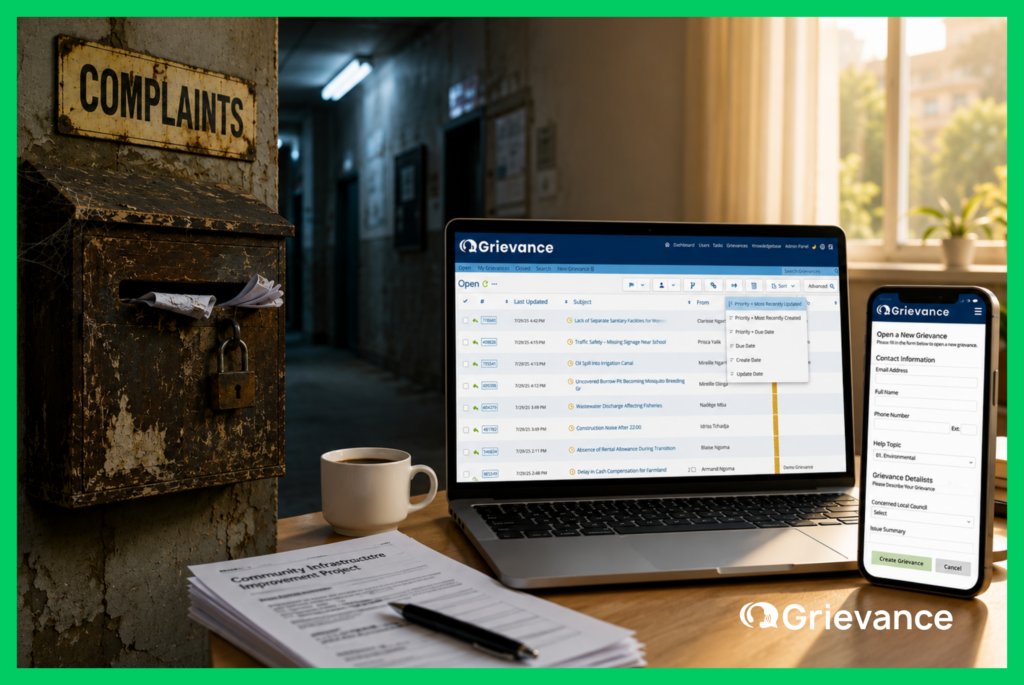
Grievance Redressal System
A 2022 World Bank review of project-level grievance redress mechanisms found that programs with structured digital intake resolved complaints 40% faster than those relying on manual channels. That number shouldn’t surprise anyone who has ever dropped a folded note into a locked wooden box and waited.
The traditional complaint box is still the default in thousands of organizations: schools, hospitals, municipal offices, and development projects. And yet the pattern is the same everywhere: complaints go in, nothing comes out. No acknowledgment. No tracking. No resolution timeline.
This article compares the two approaches side by side, not as a technology upgrade story, but as a governance decision. You’ll see where the complaint box fails, what a grievance redressal system actually changes, and how to evaluate whether your current setup is collecting feedback or just collecting dust.
Quick Definition
A grievance redressal system is a structured process for receiving, recording, investigating, and resolving complaints from stakeholders affected by an organization’s activities. In practice, it means every complaint gets a reference number, an assigned handler, a defined timeline, and a documented outcome.
The Traditional Complaint Box: What It Actually Does
Theory vs. practice in manual complaint handling
Let’s be specific about what a complaint box is. It’s a physical container, usually locked, placed in a visible location. People write complaints on paper and drop them in. Someone opens the box periodically, reads the contents, and decides what to do.
That’s the theory.
Here’s what happens in practice in most organizations: the box gets opened irregularly. Sometimes weekly. Sometimes monthly. Sometimes, only before an audit. The person who reads the complaints has no formal obligation to respond. There is no system for acknowledging receipt. There is no way for the complainant to know if their complaint was read, assigned, or acted upon.
And there is no data. No categorization. No trends. No metrics.
Having a box and having a grievance redress mechanism are two different things. Organizations point to the box during inspections and compliance reviews: “We have a mechanism.” But the gap between a locked container and a functioning complaint management system is accountability.
Where Complaint Boxes Fail: 5 Structural Problems
Failures built into the design, not caused by negligence
The failures aren’t about negligence. They’re built into the design.
Grievance Redressal System vs. Complaint Box: A Direct Comparison
What each approach makes possible or impossible
| Criteria | Traditional Complaint Box | Digital Grievance Redressal System |
|---|---|---|
| Intake channels | Paper only, single location | Web, mobile, SMS, in-person, hotline |
| Acknowledgment | None | Automatic, with reference number |
| Tracking | Impossible | Real-time, from submission to closure |
| Anonymity | Weak (handwriting, physical presence) | Strong (encrypted digital submission) |
| Routing | Manual, ad hoc | Automated to assign teams |
| Resolution timeline | Undefined | SLA-driven, with escalation rules |
| Data and analytics | None | Dashboard with trends, categories, and KPIs |
| Compliance evidence | Not auditable | Full audit trail |
| Accessibility | Limited to one physical location | Available 24/7, multilingual |
| Feedback to the complainant | Rare | Systematic status updates |
This table isn’t about digital being “better” in the abstract. It’s about what each approach makes possible, or impossible, for the organization managing complaints and for the people filing them.
Ready to close the loop between complaint intake and resolution? Grievance App helps project teams track every complaint in real time with automated workflows, multilingual forms, and lender-ready dashboards.
How a Complaint Management System Changes Organizational Behavior
Three shifts that happen immediately
The shift from a complaint box to a complaint management system isn’t a technology migration. It’s an operational change that affects how teams work, how managers make decisions, and how stakeholders perceive the organization.
Shift
When every complaint has a timestamp, an assignee, and a target resolution date, accountability stops being theoretical. Managers can see which teams resolve quickly and which let complaints stagnate. This data didn’t exist before.
Shift
A complaint box gives you a stack of paper. A complaint management system gives you categories, frequencies, locations, and timelines. If 60% of complaints in a road construction project are about dust and noise from the same village, that’s actionable information. On paper, it’s invisible.
Shift
When a complainant receives an acknowledgment, a reference number, a timeline, and a named contact, they learn that the system responds. The first acknowledgment SMS does more for trust than a year of community meetings.
What International Standards Actually Require
ESS10, IFC PS1, Equator Principles: none of them describe a locked box
Organizations operating under the World Bank’s Environmental and Social Framework (ESF) don’t get to choose between a box and a system. ESS10 requires borrowers to establish a grievance mechanism that is “accessible, inclusive, culturally appropriate, and responsive.”
The IFC Performance Standards set a similar bar. PS1 requires companies to establish a grievance mechanism for affected communities, with documentation of complaints received and actions taken.
The Equator Principles, applied by over 130 financial institutions globally, require projects to provide “an effective mechanism by which affected communities can express concerns about the environmental and social performance of the project.”
These frameworks describe processes with defined steps, timelines, documentation, and feedback loops. A grievance redress mechanism that meets these standards needs structure, not just a place to leave a note. For organizations serving communities affected by development projects, the question isn’t whether to digitize. It’s whether their current mechanism can survive an audit.
When a Complaint Box Still Makes Sense
One door into a larger process
Writing off the complaint box entirely would be dishonest. In some contexts, it plays a role.
In areas with no internet connectivity and low literacy rates, a physical complaint channel is necessary. Rural project sites, remote health clinics, and schools in areas without mobile coverage: these settings need offline intake. The point isn’t to eliminate the box. It’s to make sure the box connects to a system.
A well-designed grievance redressal system includes offline intake as one channel among several. A community liaison officer collects paper complaints and enters them into the platform. From that moment, the complaint follows the same workflow as any digital submission: logged, acknowledged, assigned, tracked.
The complaint box fails when it’s the entire system. It works when it’s one door into a larger process.
How to Evaluate Your Current Complaint Handling: 7 Questions
A self-assessment for grievance mechanism managers
If you manage a complaint mechanism and aren’t sure whether it qualifies as a grievance redressal system or a suggestion box with a padlock, run this check:
If you answered “no” to more than two of these, your mechanism has structural gaps that a complaint box cannot fill.
The Cost of Doing Nothing
Why nobody complains about the complaint system — until it’s too late
Organizations delay upgrading their complaint mechanism because it feels like a low-priority line item. The complaint box is already there. Nobody is complaining about the complaint system.
But the cost shows up in places you don’t expect.
Unresolved complaints escalate. In development projects, unaddressed grievances about land acquisition, environmental damage, or labor conditions turn into protests, legal action, and project delays. The World Bank’s own assessments show that weak grievance mechanisms are a leading indicator of project-level conflict.
In the public sector, unanswered citizen complaints erode trust in institutions. When people learn that filing a complaint produces no response, they stop engaging through official channels. They turn to social media. Or to the streets.
The cost of a complaint management system is measurable. The cost of not having one is harder to quantify, but higher.
Building a Grievance Redressal System That Works
Five operational requirements for a complete mechanism
An effective system doesn’t need to be complex. It needs to be complete. That means covering five operational requirements.
Grievance App covers each of these requirements in a single platform, from multilingual intake forms to real-time dashboards, designed specifically for organizations running projects with affected communities.
In Summary — Key Takeaways
Complaint box vs. grievance redressal system: a governance decision
For Project Managers, Compliance Officers & Governance Teams
Replace the box with a system that acknowledges, tracks, and resolves.
Grievance App helps organizations move from paper-based complaint handling to fully digital, standards-compliant grievance management, on any device, in any language.
Frequently Asked Questions
Answers to the most common questions about grievance redressal systems, complaint boxes, and compliance requirements.
What is a grievance redressal system? +
A grievance redressal system is a formal process for receiving, recording, investigating, and resolving complaints filed by stakeholders such as citizens, employees, or communities affected by a project. It includes intake channels, acknowledgment, tracking, resolution workflows, escalation, and reporting. The term is widely used in public administration and international development.
What is the difference between a complaint box and a grievance mechanism? +
A complaint box is a single-channel, paper-based intake point with no tracking, routing, or feedback loop. A grievance mechanism is a complete process that covers intake, acknowledgment, investigation, resolution, appeal, and reporting. The box collects complaints. The mechanism resolves them.
Why do traditional complaint boxes fail? +
They fail because they lack structure. No acknowledgment to the complainant, no assignment to a handler, no defined timeline, no escalation path, no data capture, and no way to verify that complaints were read or acted upon. People stop using systems that produce no response.
How does a digital grievance system improve accountability? +
It creates a documented trail. Every complaint gets a timestamp, a reference number, an assigned handler, and a resolution deadline. Managers see open cases, overdue cases, and resolution rates. This makes inaction visible and measurable.
What are the World Bank requirements for grievance redress mechanisms? +
Under ESS10 of the Environmental and Social Framework, World Bank borrowers must provide a grievance mechanism that is proportionate, culturally appropriate, accessible, and transparent. The mechanism must allow affected parties to raise concerns and receive timely responses. It must be documented, with records of complaints received and outcomes.