
What Works: Digital Grievance Redress Mechanism in Kenya, Uganda and Tanzania
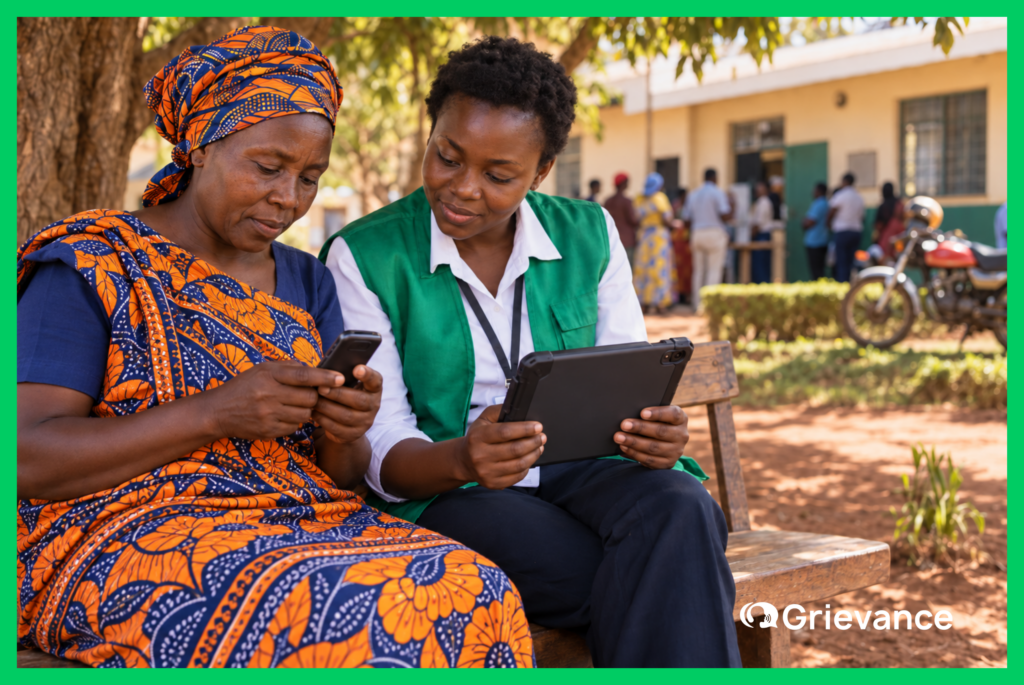
Digital Grievance Redress Mechanism in Kenya, Uganda and Tanzania
53.4 million. Kenya added two million mobile money subscriptions in the third quarter of the 2025/26 financial year, reaching 53.4 million, and the regulator now puts mobile money penetration at 100.1% (Communications Authority of Kenya data). Almost every adult can move money from a basic phone.
Many project complaint systems in the region still depend on suggestion boxes and paper logbooks. Complaints get lost, escalations stall, and safeguards teams discover problems during audits instead of during implementation.
This article maps how a digital grievance redress mechanism in Kenya, Uganda and Tanzania actually works today: which public systems lead, how extractive and donor-funded projects run their grievance channels, and the design decisions that separate a functioning GRM from a compliance checkbox.
Quick Definition
A digital grievance redress mechanism (GRM) is a system that receives, registers, routes, tracks, and resolves complaints from affected people through electronic channels such as SMS, USSD, web forms, mobile apps, and call centres. In practice, every complaint gets a reference number, an owner, a deadline and an audit trail, whether it arrived by phone or at a village office.
Why East Africa Became the Testing Ground for Digital GRM in Africa
Mobile reach, public systems and megaprojects
Three conditions came together in East Africa earlier than in most of the continent.
First
Kenya’s SIM subscriptions reached 78.4 million by December 2025, a penetration rate of 149.5%. Uganda and Tanzania have smaller numbers, but basic-phone coverage in rural areas is wide enough to make SMS and USSD viable intake channels.
Second
Governments built complaint systems into public administration rather than leaving them to individual projects. Tanzania and Kenya both run national platforms with legal or policy backing, which gives donor-funded projects something to connect to.
Third
The region hosts some of Africa’s largest infrastructure and extractive investments. Large-scale land acquisition generates large volumes of grievances, and lenders applying IFC Performance Standard 1 and the World Bank Environmental and Social Framework require project-level mechanisms that can prove what happened to each complaint.
The result: East Africa offers working models at three levels. National government, donor-funded programmes, and private-sector megaprojects. Each teaches something different.
How the Digital Grievance Redress Mechanism in Kenya Took Shape
The Ombudsman model: online intake backed by physical desks
Kenya’s anchor institution is the Commission on Administrative Justice (CAJ), the Office of the Ombudsman.
CAJ’s Complaints Management Information System was built with support from GIZ’s Good Governance Programme, and lets the public lodge complaints and follow their progress online. During the pilot phase, the portal received 497 complaints from the public. At launch, the Commission’s chairperson said the system would reach people in areas without physical CAJ offices.
Two design choices stand out.
The first is speed of triage. According to CAJ, a complaint submitted through the public portal is allocated within one day to an officer who reviews it for admissibility. A fixed first-response window is what makes a GRM credible to complainants.
The second is channel integration with physical service points. Complainants can also get help and status updates at CAJ desks inside Huduma Centres in towns including Kakamega, Nyeri, Nakuru, Meru and Nairobi. Digital intake did not replace walk-in access. It sat behind it.
The scale is significant. CAJ reports resolving more than 920,000 complaints since 2011 and is developing a mobile app, the PASHA Ombudsman platform, with the Ministry of Public Service. Its own analysis shows that service delays account for 22.6% of grievances, and unlawful official conduct for 18%.
The delay figure matters for project teams. If delay is the top complaint category in public services, it will also dominate complaints about compensation, resettlement and contractor payments. A Kenyan project GRM that cannot track time-to-resolution is blind to its biggest risk.
Tanzania: e-Mrejesho and the National Platform Model
One grievance system for all of government
Tanzania has gone furthest in building a single national grievance system for all government.
e-Mrejesho, developed by the e-Government Authority (e-GA), captures citizen feedback, from complaints to compliments, and uses AI to route each message to the responsible department, then tracks the response. Version 1 won the United Nations Public Service Award in 2024, and Version 2 won the eGovernment category at the 2025 WSIS Awards.
The 2026 upgrade shows where the model is heading. The “Sema na Kiongozi” (Speak to a Leader) feature lets citizens submit complaints through the website, the mobile app, or USSD code *152*00#, and choose which level of leadership should receive them. Regional and district commissioners can review cases, issue directives, and follow up on actions until each matter is closed, under the 2023 Citizen Feedback Handling Guidelines.
Three lessons for practitioners:
Access
A short code works on any phone, with no data bundle and no app store.
Accountability
The UN noted that e-Mrejesho makes complaints visible to senior officials, which builds accountability inside institutions.
Integration
Tanzania’s government systems increasingly connect through the Government Enterprise Service Bus, so feedback data can flow into performance management.
For donor-funded projects in Tanzania, the implication is direct. Your project GRM should be able to refer cases into, or receive referrals from, the national channel. Running a parallel system that citizens have never heard of reduces uptake.
Uganda: SMS Heritage and Extractive-Sector Grievance Mechanisms
From U-Report to the EACOP pipeline
Uganda pioneered SMS citizen feedback on the continent. UNICEF Uganda launched U-Report in May 2011 as a free SMS tool for young people to share views on issues affecting them, and evidence from Uganda informed its expansion to more than 20 countries.
The World Bank later used the same infrastructure for project feedback. A Bank team noted that U-Report’s network of 200,000 voluntary users in Uganda allowed it to collect targeted beneficiary feedback quickly and with wide reach.
Humanitarian operations followed. UNHCR and the Office of the Prime Minister launched an inter-agency Feedback, Referral and Resolution Mechanism for refugees, including Uganda’s first centralised toll-free helpline, alongside protection desks and complaint boxes. More recently, the Uganda Red Cross deployed digital feedback tools that support several languages and offline data collection, designed to work in low-connectivity areas.
The extractive sector is where stakes are highest. The East African Crude Oil Pipeline will run 1,443 km from Kabaale–Hoima in Uganda to the Chongoleani Peninsula near Tanga in Tanzania. In Tanzania alone, officials reported 9,513 Project Affected Persons, of which 331 were physically displaced.
EACOP’s Grievance Management Procedure sets out steps for receiving, acknowledging, registering, investigating and resolving complaints from all affected stakeholders (EACOP grievance procedure). Its human rights manager has described a structure with village-level access points, district consultative committees and local offices, and community feedback led to route adjustments to avoid graveyards.
That is what a grievance mechanism in East Africa looks like when it works: complaints change decisions. Civil society has also pushed back, with Oxfam calling for properly equipped community grievance committees and a clearly explained referral pathway. Both points are design requirements, not public relations problems.
Kenya, Uganda and Tanzania Compared
Flagship systems, channels and legal anchors
| Country | Flagship public system | Main intake channels | Data protection law | Strongest sector model |
|---|---|---|---|---|
| Kenya | CAJ Complaints Management Information System | Web portal, walk-in Huduma desks, toll-free line | Data Protection Act, 2019 | Public administration, ombudsman oversight |
| Tanzania | e-Mrejesho (e-GA) | Web, mobile app, USSD *152*00#, free SMS | Personal Data Protection Act, 2022 | National, whole-of-government platform |
| Uganda | No single national GRM; sector and project systems | SMS, toll-free helplines, community committees | Data Protection and Privacy Act, 2019 | Humanitarian feedback, extractive-sector GRMs |
The pattern is clear. Tanzania centralises. Kenya anchors in an independent oversight body. Uganda relies on a dense network of programme-level mechanisms. A regional programme operating in all three must adapt its GRM to each model rather than impose one design.
How to Design a Grievance Mechanism in East Africa: 7 Steps
From basic-phone intake to closing the loop
Steps 3 and 4 fail most often. Field teams log complaints in notebooks, a monthly spreadsheet arrives late, and nobody can say how long the oldest open case has waited. Uganda’s Inspectorate of Government shows how quickly volume builds even at national level: it received 2,377 complaints in financial year 2023/2024. Without a shared register and deadline tracking, a project with a few hundred cases a month loses control.
Grievance App was built for this exact workflow: multichannel intake into one register, SLA-based escalation by administrative level, role-based access for field officers and safeguards leads, and offline capture for areas without coverage. Discover how Grievance App helps East African project teams track every complaint from village to district.
Where East African GRMs Still Break Down
Four failure points digital intake alone does not fix
Digital channels solve intake. They do not solve everything.
Uptake
A short code nobody knows about receives no complaints. Projects that publicise channels at community meetings, on radio and on printed brochures in local languages see higher uptake.
Safety
Complainants in land acquisition contexts worry about losing compensation. Anonymous submission and confidential handling must be real options, with access to identity restricted by role.
Coordination
A single district can host a county or local government system, a national platform, a contractor’s mechanism, and a lender’s own channel. Without referral rules between them, complainants bounce from one to another.
For a structured approach to these issues, see our grievance tracking system implementation roadmap and our guide to what a grievance redress mechanism requires. To measure whether your mechanism is working, track the complaint management KPIs that lenders and auditors check first.
Conclusion
The gap now sits inside individual programmes
Mobile reach is no longer the barrier in East Africa. Tanzania and Kenya have proven that national complaint systems can operate at scale, and Uganda’s extractive and humanitarian sectors show that project GRMs can change real decisions. The gap now sits inside individual programmes: complaints captured on paper, deadlines nobody tracks, and outcomes nobody reports back.
Closing that gap is what turns a digital grievance redress mechanism in Kenya, Uganda, or Tanzania from a donor requirement into an early warning system for your project. If your team manages grievances across several districts or countries, the next step is a register that every channel feeds and every supervisor can see, which is exactly what dedicated grievance tracking software provides.
In Summary: Key Takeaways
Three models, one set of design rules
For Safeguards Teams, Programme Directors & GovTech Leads in East Africa
Discover how Grievance App helps East African teams resolve grievances faster and stay audit-ready.
Multichannel and multilingual intake, offline capture, SLA-based escalation by administrative level and audit-ready reporting, aligned with World Bank ESS10 and IFC Performance Standards.
Frequently Asked Questions
Direct answers to the questions practitioners in Kenya, Uganda and Tanzania ask most about grievance mechanisms.
What is a grievance redress mechanism in Kenya? +
A grievance redress mechanism in Kenya is a formal process for receiving and resolving complaints about public services or development projects. At the national level, the Commission on Administrative Justice handles complaints about public administration through its online portal and Huduma Centre desks. Donor-funded projects must also run their own GRMs under World Bank, AfDB or IFC requirements, often linked to county structures.
How do I file a complaint on e-Mrejesho in Tanzania? +
You can submit feedback on e-Mrejesho through its website, its mobile app, or the USSD code *152*00#, which works on any phone without internet. The “Sema na Kiongozi” option lets you direct your complaint to regional or district leadership. Each submission is routed to the responsible institution and tracked until it is resolved.
Do World Bank projects in Uganda require a grievance mechanism? +
Yes. Under the World Bank Environmental and Social Framework, specifically ESS10 on stakeholder engagement, every financed project must operate an accessible grievance mechanism proportionate to its risks. In Uganda, the Bank also runs a dedicated hotline for discrimination complaints on its funded projects, alongside its corporate Grievance Redress Service.
What channels work best for a digital GRM in rural East Africa? +
USSD and SMS work best in rural East Africa because they run on basic phones without data. Toll-free voice lines serve people with low literacy. Walk-in desks and community committees remain necessary for older residents and sensitive cases. The most effective GRMs combine all of these and record every complaint in one central register.