
Why Every Organization Needs a Digital Grievance Redress Mechanism (GRM) in 2026
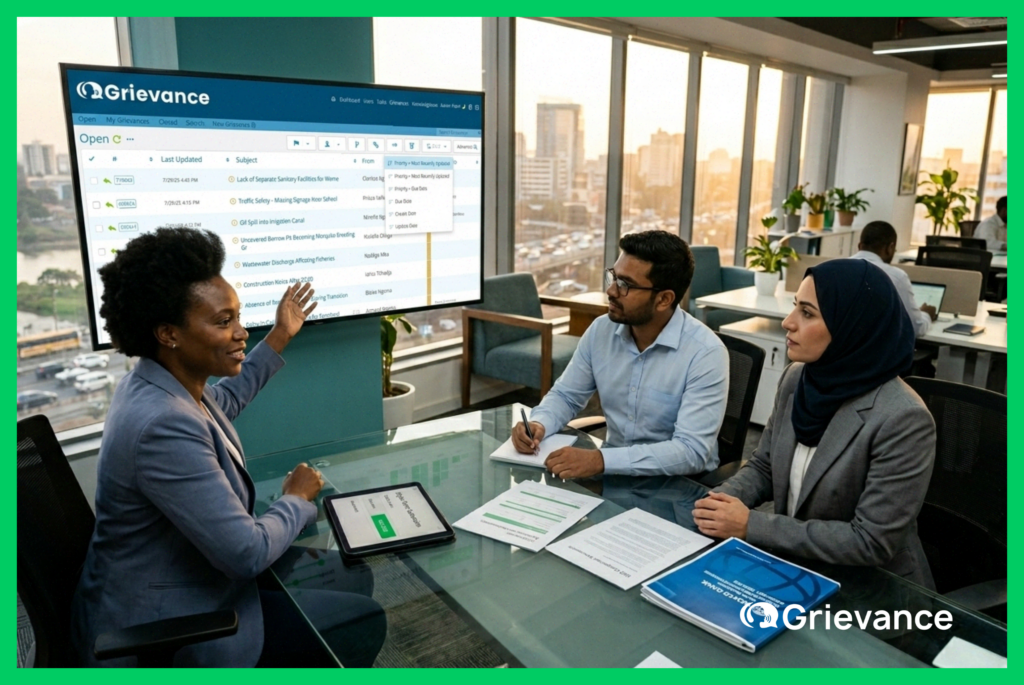
Grievance Redress Mechanism (GRM) in 2026
By GRM Governance Expert · July 2025 · 8 min read
Picture this: a community living near an infrastructure project submits a noise complaint through a paper form. The form sits in a pile. Three weeks later, a local newspaper runs a front-page story about the project’s disregard for residents. An international donor threatens to suspend funding. A reputation built over years begins to crack.
This scenario is not hypothetical. It happens every year to organisations that have yet to implement a structured, digital grievance redress mechanism. In 2026, stakeholder expectations have fundamentally shifted. Transparency and accountability are no longer diplomatic gestures; they are operational requirements enforced by donors, regulators, and the community organisations they serve.
A grievance redress mechanism, when properly designed and digitised, transforms complaints from threats into strategic intelligence. The question is no longer whether your organisation needs one. The question is how long you can afford to operate without it.
Key Definition
GRM
A digital grievance redress mechanism centralises every complaint, from intake to closure, in a single auditable system, tracking every action, enforcing every deadline, and generating compliance-ready reports on demand.
What Exactly Is a Grievance Redress Mechanism and Why Does “Digital” Change Everything?
A grievance redress mechanism, often abbreviated as GRM, is a formalised process through which individuals, communities, or organisations can raise concerns, report problems, and receive documented responses from an accountable body. The concept is not new. What is new and profoundly consequential is the shift from paper-based, slow-moving systems to dynamic digital platforms designed for real-world complexity.
In its traditional form, a GRM might consist of a suggestion box, a phone hotline, or a designated staff member receiving written complaints. These approaches share a common weakness: they are invisible, untraceable, and difficult to audit. A complaint submitted on a paper form may be lost, delayed, or resolved inconsistently.
A digital grievance redress mechanism solves all of this at once. It is a structured platform accessible via web browser, mobile application, or SMS that receives complaints in real time, routes them to the appropriate team, tracks every action taken, and notifies the complainant at each stage of the process. Every case is timestamped, categorised, and stored in a secure, auditable database.
This shift matters enormously for organisations operating in regulated environments. The World Bank’s Environmental and Social Framework explicitly requires project-level GRMs as a condition of funding. A digital GRM is not simply a best practice anymore in many sectors; it is a contractual obligation.
The Real Cost of Managing Grievances Manually in 2026
Organisations that have not yet digitised their complaint management processes are paying a price they rarely see itemised. The cost is distributed across delayed resolutions, staff time spent on administrative tracking, missed early warning signals, and, most expensively, reputational damage that compounds over time.
The data tells a consistent story. Organisations that implement a structured grievance redress mechanism report faster resolution times, higher community trust scores, and significantly lower rates of complaint escalation to external authorities. The investment in a digital GRM is, in practice, an investment in organisational risk management, one that pays for itself the first time it prevents a preventable crisis.
Five Strategic Benefits of a Digital Grievance Redress Mechanism
Each benefit addresses a distinct dimension of organisational risk from regulatory compliance to stakeholder trust, making a digital GRM one of the highest-leverage investments available to governance-focused organisations.
Looking to see these features in action? Grievance App is built specifically for organisations that need to meet IFC, World Bank, and ESG grievance standards, with configurable workflows, anonymous intake, and audit-ready reporting.
Why 2026 Is the Inflexion Point for Grievance Management
Several converging forces make 2026 a decisive year for organisations that have not yet adopted a digital grievance redress mechanism.
Stakeholder expectations have been permanently recalibrated by digital experience. Individuals who routinely track the status of a food delivery in real time find it difficult to accept an opaque, slow-moving complaint process.
Platforms like Grievance.app now offer semantic categorisation of incoming complaints, automated routing based on subject matter and urgency, multilingual support, and predictive analytics, capabilities once available only to large institutions.
Monitoring and evaluation teams from major international funders now conduct field visits specifically to assess whether GRM systems are functional, accessible, and used. A digital GRM that produces auditable data is increasingly the only system that meets this bar.
“
The days of satisfying a funding requirement with a paper-based GRM that exists on an organizational chart but functions poorly in practice are effectively over. In 2026, a digital GRM that produces auditable data is the only system that meets the bar set by major international funders.
How to Implement a Digital Grievance Redress Mechanism That Actually Works
Implementation is where many well-intentioned GRM efforts falter. A platform exists, but no one knows about it. Forms are available, but the complaint categories do not match the issues stakeholders actually face. The starting point is a genuine audit of organisational needs. The following five-stage roadmap reflects implementation best practices aligned with IFC, World Bank, and ESG standards.
Conduct a genuine audit of organisational needs. What types of complaints are most common? Which stakeholders are least likely to use a digital channel without specific outreach and support? What languages need to be accommodated? What response timelines are realistic given the organisation’s capacity? The answers to these questions should shape every subsequent decision.
Platform selection should prioritise compliance, usability, and integration capability. A solution like Grievance.app is built specifically for the requirements of NGOs, public institutions, and donor-funded projects, with features designed around World Bank and UN GRM standards, multilingual interfaces, anonymous reporting, and real-time dashboards.
Staff who receive and process complaints need to understand not only how to use the system but why the process matters, what the complainant’s experience looks like from the other side, and why response quality and timeliness directly affect organisational credibility. A well-trained team is the human infrastructure that makes a digital GRM genuinely effective.
Communication campaigns targeted at communities, staff, partner organisations, and beneficiaries need to explain clearly how to access the system, what to expect after submission, and what the organisation’s commitment to the process actually means in practice.
Analyse data regularly to identify recurring failure points, refine internal processes, and adapt service delivery. The GRM that generates the most value is one whose insights are actively used, not one that collects data that no one reviews.
What you need to remember about digital GRMs in 2026
A Digital GRM Is Not Optional in 2026; It Is Foundational
Organisations that entered 2026 without a functional, digital grievance redress mechanism did so at measurable risk to their reputation, their funding relationships, and their operational resilience. The compliance landscape has shifted. Stakeholder expectations have risen. The technical barriers have fallen. There is no longer a credible reason to delay.
The organisations that will earn and sustain stakeholder trust over the next decade are those that treat complaint management not as a regulatory formality but as a strategic capability, one that generates intelligence, demonstrates accountability, and converts dissatisfaction into improvement.
Grievance.app was built for exactly this purpose. It is compliant with international GRM standards, intuitive for both staff and complainants, and designed to grow with your organisation’s needs.
Request a Free Demo and See Grievance.app in Action
Regulatory frameworks are tightening. ESG disclosure requirements are expanding. Affected communities and workers have more channels than ever to escalate unresolved concerns. A structured grievance mechanism is no longer a best practice; it is a baseline expectation for any accountable organisation.
Frequently Asked Questions
Everything you need to know about digital grievance redress mechanisms, how they work, who needs them, and what makes them compliant.
What is a Grievance Redress Mechanism (GRM) and who needs one?+
A Grievance Redress Mechanism is a structured, formalised process that allows stakeholders, including community members, employees, beneficiaries, or partner organisations, to submit concerns, complaints, and feedback to an accountable body and receive documented, timely responses. Any organisation managing public-facing programs, donor-funded projects, or community relationships needs one. This includes NGOs, government agencies, development banks, energy and infrastructure companies, and international institutions operating under ESG or social compliance frameworks.
How does a digital GRM differ from a traditional complaint system?+
A traditional complaint system based on paper forms, suggestion boxes, or unstructured email produces records that are difficult to track, audit, or analyse at scale. A digital grievance redress mechanism centralises all submissions in a single platform, assigns case numbers automatically, routes complaints to the appropriate team, sets response deadlines, notifies complainants of progress, and generates analytics reports. The result is a system that is faster, more transparent, more accountable, and significantly easier to audit.
Is a digital GRM required for World Bank or UN-funded projects?+
Yes. The World Bank’s Environmental and Social Framework and the UN’s operational policies both require project implementers to establish accessible, functional grievance mechanisms as a condition of funding. International donors increasingly assess GRM quality, not just existence, during monitoring visits. A digital platform that produces auditable data and demonstrates real usage is now effectively the standard expected by major funding institutions.
How long does it take to implement a digital GRM with Grievance.app?+
Implementation timelines vary depending on organisational complexity, the number of languages required, and integration needs. Grievance.app is designed for rapid deployment; most organisations are operational within days of setup, with full customisation of complaint categories, response workflows, and reporting dashboards. The platform’s documentation and support team guide organisations through every stage of implementation.
Can a digital GRM handle anonymous complaints?+
Yes, and this feature is often critical for effectiveness. In many contexts, including communities adjacent to infrastructure projects or employees in hierarchical organisations, complainants will not report genuine concerns if they cannot do so anonymously. Grievance.app supports anonymous submission while maintaining full internal traceability, ensuring that the organisation can act on complaints without exposing the identity of the person who submitted them.