
How a Digital Service Delivery Complaints System Can Stop South Africa’s Protest Cycle Before It Starts
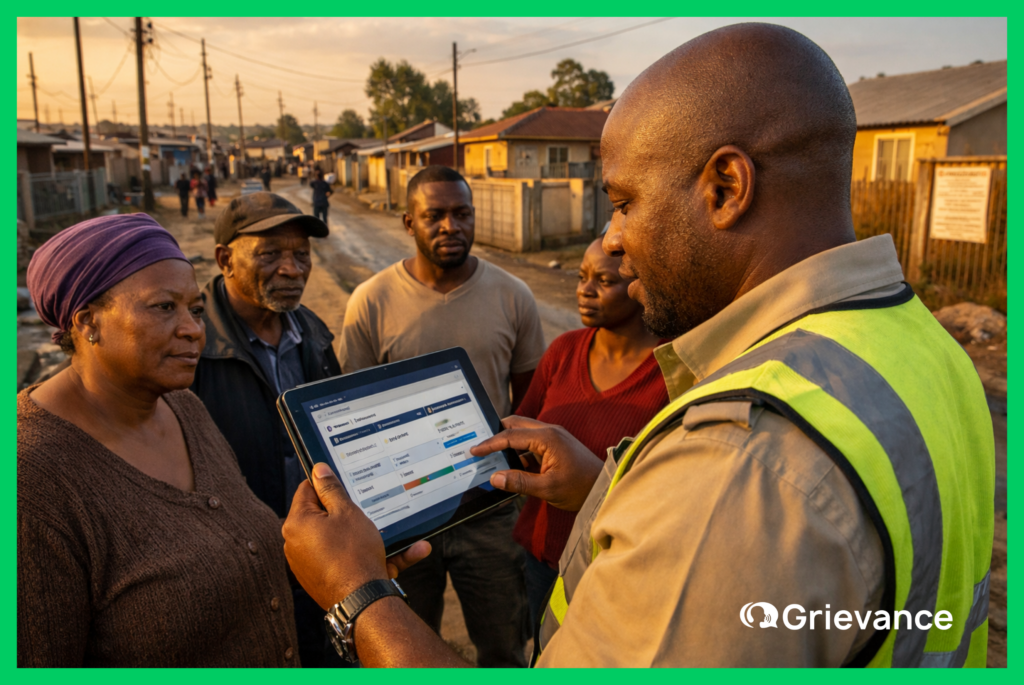
Digital Service Delivery Complaints System
122 service delivery protests in just six months. That was South Africa’s reality in the first half of 2024 alone, and the cycle shows no sign of breaking. Behind every burning tyre and barricaded road is a complaint that was never acknowledged, a fault report that vanished, and a resident who ran out of patience.
The real question for municipal leaders isn’t why communities protest. It’s why grievances are still reaching the streets before they reach a responsible official. A well-designed service delivery complaints system in South Africa changes that equation entirely, by intercepting frustration early, creating accountability trails, and restoring the one thing that prevents unrest: trust.
Quick Definition
A digital Grievance Redress Mechanism (GRM) is a structured, institutionalised channel through which residents can submit, track, and receive resolutions to complaints about public services via mobile, USSD, or web. In practice, it means a resident reporting a water outage gets an automatic case reference number, a response deadline, and a real-time status update, rather than silence followed by a three-week wait and a decision to join a march.
Why Service Delivery Protests Persist: The Accountability Gap
Understanding the communication failure at the heart of local government
South Africa’s protest landscape is not primarily a resource problem; it is a communication failure. More than 2 million people have taken to the streets every year since 2008, driven by grievances around water, electricity, housing, and sanitation. Yet the mechanism to intercept those grievances before they turn volatile is almost universally absent at the ward level.
The four most common protest triggers follow a predictable, preventable pattern. In each scenario, the precipitating issue is not only the service failure itself, but it is the absence of a credible, responsive channel through which the complaint could have been received, acknowledged, and acted upon.
Water & Sanitation
Residents report verbally. Nothing happens. They escalate, still nothing. The street becomes the last resort when every formal channel has failed silently.
Electricity & Billing
An incorrect invoice triggers a complaint that disappears; no case number is issued. No callback arrives. Frustration compounds with every new bill.
Housing Backlogs
Beneficiaries on housing lists have no way to check their position. Opacity breeds suspicion. Suspicion breeds anger. Anger fills the street.
Infrastructure & Waste
Crumbling roads and missed refuse pickups communicate to communities that they are being ignored, regardless of whether a budget allocation actually exists.
5 Design Principles of an Effective Community Complaints Portal
What separates a digital GRM that prevents protests from one that accelerates them
Not every digital system prevents protests. A complaints portal that logs tickets but never resolves them, or resolves them without communicating back, can accelerate distrust faster than having no system at all. Best-in-class implementations of a community complaints portal in South Africa share five non-negotiable design principles:
Looking for a platform that delivers all five principles out of the box? Grievance App combines multi-channel intake, automatic SLA escalation, real-time tracking, and municipal analytics, built for the African governance context.
The ROI Argument: Why Prevention Costs Less Than Response
The financial and governance case for investing in a digital grievance redress mechanism for municipalities
The financial case for a digital grievance redress mechanism for municipalities is routinely underestimated by budget committees. A single medium-scale protest, road blockades, police response, property damage, and municipal staff downtime routinely costs more than three years of a digital GRM subscription.
| Cost Category | Post-Protest Cost (per incident) | Digital GRM Annual Cost |
|---|---|---|
| Infrastructure damage | R50,000 – R500,000 | — |
| Law enforcement deployment | R80,000 – R200,000 | — |
| Service disruption losses | Uncapped | — |
| GRM platform subscription | — | R15,000 – R80,000 |
| Staff training & onboarding | — | R5,000 – R20,000 |
| Complaint resolution workflow | — | Built-in, automated |
Beyond the direct financial calculus, there is a governance dividend that is harder to quantify but structurally more significant. Municipalities that operate transparent, responsive complaint systems demonstrate accountability. Accountability builds legitimacy. Legitimacy reduces the motivation to protest, even when service delivery remains imperfect.
Communities do not demand perfection. They demand acknowledgment, honesty, and progress. A digital GRM delivers all three systematically, for less than the cost of a single police deployment.
According to best practices endorsed by the IFC Performance Standards and the World Bank ESF/ESS10, a functional GRM is now a safeguard requirement for all development-financed projects, a standard South African municipalities are increasingly expected to meet as they access concessional funding and international grants.
Implementation Roadmap: Deploy a Digital GRM in 90 Days
A proven phased approach aligned with World Bank and African Development Bank frameworks
Organisations that have implemented effective digital grievance systems, including ministries across West Africa and regional bodies aligned with World Bank ESF standards, report that a phased rollout over 90 days is both realistic and sufficient for initial deployment.
Public disclosure of GRM performance data, even when it reveals gaps, consistently increases community confidence in local governance structures, according to best practices endorsed by the African Development Bank. Transparency is itself a protest-prevention tool.
In Summary — Key Takeaways
What every municipal leader needs to know about digital GRM and protest prevention
For Municipal Leaders & Development Partners
Stop Managing Protests. Start Preventing Them.
Grievance App is a purpose-built GRM platform trusted by the African Union, ECOWAS, UNDP, and World Bank-financed projects. Multi-channel intake, real-time tracking, SLA escalation, and compliance dashboards, configured for the South African municipal context.
Frequently Asked Questions
Everything municipal managers, development partners, and civil society advocates need to know about digital GRMs and service delivery accountability.
What is a grievance redress mechanism in South Africa? +
A grievance redress mechanism (GRM) in South Africa is a formal system that allows residents to submit, track, and receive resolutions to complaints about public services, such as water, electricity, housing, or sanitation. In its digital form, it provides an accessible, traceable channel that operates via mobile, USSD, or web, replacing informal and often unresponsive reporting channels at the municipal level.
How can municipalities reduce service delivery protests in South Africa? +
Municipalities can reduce service delivery protests by deploying a structured digital complaints system that acknowledges every submission within 24 hours, assigns SLA-bound response timelines, and provides residents with real-time case tracking. Pattern analytics built into the system also allow officials to detect emerging hotspots before frustration escalates to street-level action.
What digital tools help communities report service failures to local government? +
Effective tools include digital GRM platforms that support multi-channel submission (USSD, web form, mobile app), provide automatic case reference numbers, and route complaints directly to the responsible department. Platforms like Grievance App are purpose-built for this use case, with dashboards for case management, SLA monitoring, and performance reporting aligned with World Bank ESF/ESS10 standards.
Is a digital GRM required for World Bank-funded municipal projects? +
Yes. The World Bank’s Environmental and Social Framework (ESS10) mandates that all borrowers establish and maintain an accessible grievance mechanism for project-affected parties. Digital platforms are increasingly the preferred implementation method due to their scalability, auditability, and accessibility across diverse connectivity environments.
How long does it take to implement a community complaints portal for a municipality? +
A structured deployment typically takes 60 to 90 days from design to full rollout, depending on the number of service categories and wards involved. This includes system configuration, staff training, community awareness campaigns, and a pilot phase in 2–3 wards before municipality-wide scaling. Grievance App provides dedicated onboarding support throughout each phase.
Related Reading