
Case Study: How an NGO Can Transform Community Engagement with a Grievance App
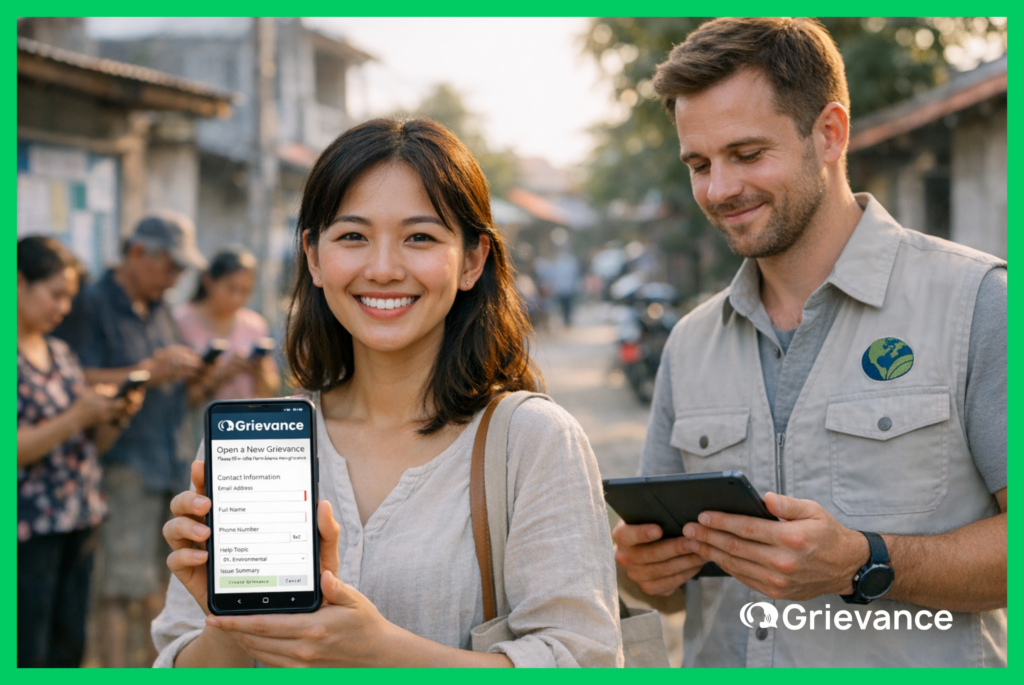
Across the humanitarian and development sectors, one persistent challenge remains difficult to solve: making community feedback genuinely matter. NGOs mobilize significant resources, deploy skilled teams, and design programmes with care, yet the communities they serve frequently feel unheard, underserved, and disconnected from the decisions that shape their lives. Poor NGO community engagement does not just erode trust; it actively undermines programme effectiveness, triggers escalation risks, and puts donor compliance at stake.
The root cause is rarely a lack of goodwill. It is a lack of structure. Complaints arrive via informal channels, a phone call here, a verbal exchange there, only to fall through the cracks of an overwhelmed coordination team. There is no single record, no assigned owner, no binding timeline, and no mechanism to convert individual grievances into systemic improvements.
This article presents a detailed case study of how a mid-sized humanitarian NGO replaced its fragmented complaint process with a structured, digital Grievance Redress Mechanism (GRM). By adopting a purpose-built grievance app, the organisation achieved measurable gains in responsiveness, accountability, and stakeholder engagement across its field operations. More importantly, it transformed community complaints from a reputational liability into a continuous learning asset, the very definition of a high-performing feedback loop.
Whether you lead a MEAL function, manage safeguarding responsibilities, or oversee programme compliance, the lessons in this case study apply directly to your organisation’s accountability architecture.
The Challenge: When Community Feedback Disappears Into Silos
Fragmented intake channels undermine stakeholder engagement
The NGO in this case study, an international implementing partner operating across three countries with over 350 field staff, was running eight concurrent programmes in WASH, food security, and urban livelihoods. Each programme had its own informal mechanism for receiving community feedback: suggestion boxes, hotline numbers, community liaison officers, and WhatsApp groups maintained by individual project managers.
The consequences were predictable. Complaints were logged inconsistently, response times varied wildly between sites, and senior management had no consolidated view of programme-level tensions. During a mid-term donor review, the organisation struggled to demonstrate its Accountability to Affected Populations (AAP) commitments with any documentary evidence. A corrective action plan was requested.
The hidden cost of weak community accountability systems
Beyond donor relations, the operational damage was significant. Communities in two districts had begun bypassing the NGO entirely, escalating complaints directly to local authorities, a clear signal of broken trust. Staff turnover in the MEAL team was high, partly due to the frustration of managing complaints manually in spreadsheets with no clear escalation protocol. And because no trend data was being collected, recurring issues, repeated delays in cash transfer disbursements, and water point maintenance failures went unaddressed for months.
This scenario is far from exceptional. According to the Core Humanitarian Standard (CHS), meaningful participation and feedback mechanisms are foundational commitments, yet compliance gaps are consistently identified in peer review cycles. The problem is systemic, and it requires a systemic solution.
The Solution: Deploying a Digital GRM with Grievance App
Designing a multi-channel NGO community engagement architecture
After evaluating several platforms, the organisation selected Grievance App as its end-to-end GRM solution. The deployment began with a three-week configuration sprint involving the MEAL Director, the Safeguarding Focal Point, and two programme managers. The goal was to map existing intake touchpoints to a unified digital workflow without disrupting ongoing operations.
Grievance App’s multi-channel intake capability allowed communities to submit concerns via web form, mobile interface, SMS integration, or through staff-assisted data entry at field offices, a critical consideration in low-connectivity environments. Crucially, the platform supports anonymous submission in multiple languages, removing the single most cited barrier to community reporting: fear of identification and retaliation. All submissions were automatically timestamped, categorised by programme and site, and assigned a unique case reference shared immediately with the complainant.
Automating workflows to accelerate resolution timelines
One of the platform’s most impactful features was its automated routing and escalation engine. Cases were assigned to the relevant programme team based on pre-configured rules (by geography, complaint category, and severity level). If a case was not acknowledged within 48 hours, an automatic reminder was triggered. If it remained unresolved beyond the SLA threshold, it escalated to the Programme Director with a notification log.
This single change, moving from manual triage to automated assignment, reduced average first-response time from 11 days to under 3 days within the first quarter of deployment. Teams no longer had to chase ownership; the system enforced it.
Role-based access and confidentiality controls for sensitive cases
For PSEA (Protection from Sexual Exploitation and Abuse) and safeguarding cases, confidentiality is not optional; it is a legal and ethical imperative. Grievance App’s role-based access control allowed the organisation to create a restricted case lane visible only to the Safeguarding Officer and designated senior management, completely separated from routine programme complaints. Activity logs ensured full auditability without exposing case details to unauthorised staff. This architecture met the organisation’s internal safeguarding policy requirements and aligned with donor compliance frameworks, including GDPR and World Bank ESF Standard 10.
Measurable Outcomes: From Complaints to Continuous Improvement
Quantified improvements in NGO community engagement and responsiveness
Six months after full deployment, the organisation conducted an internal performance review. The results were compelling across every accountability indicator tracked:
- First-response time dropped from an average of 11 days to 2.8 days, a 75% improvement.
- Case resolution rate within the SLA window rose from 34% to 81%.
- Community satisfaction scores (measured via a post-resolution SMS survey) averaged 4.1 out of 5.
- Escalation to external bodies fell by 62% in the two districts where trust had previously broken down.
- Donor reporting time for GRM compliance sections was reduced by an estimated 40%, as dashboards generated exportable summary reports automatically.
Beyond the quantitative results, qualitative feedback from community focus groups indicated a measurable shift in perception. Participants no longer viewed the complaint process as a performative exercise; they reported feeling that their concerns produced visible responses, and in several documented cases, corrective actions that tangibly improved service delivery.
Using trend analytics to drive programme-level corrective action
Perhaps the most strategically significant outcome was the organisation’s newfound ability to act on patterns rather than isolated incidents. Grievance App’s analytics dashboard revealed that approximately 28% of all complaints across two WASH programmes were related to a single issue: inconsistent communication about maintenance schedules.
This was not a resource problem. It was a communication and coordination failure that had been invisible because no aggregated data had previously existed. Once surfaced, programme management introduced a simple SMS notification system for maintenance windows, a low-cost intervention that eliminated the complaint category within eight weeks. This is the core promise of a well-designed GRM: converting reactive case management into proactive systems improvement.
“For the first time, we could show our donors exactly how we were handling community concerns, not just that a mechanism existed, but that it worked. That changed the conversation entirely.”
— MEAL Director, International NGO (composite quote)
Key Principles for Successful GRM Implementation
Technology enables community engagement, and trust sustains it
The most important lesson from this deployment is not technological. It is cultural. A digital GRM only functions if communities believe their input will be received without retaliation and acted upon within a reasonable timeframe. Grievance App provides the infrastructure, multi-channel access, anonymity, automated timelines, and audit trails, but the NGO must invest equally in community-level communication: explaining what the mechanism is, how it works, who handles cases, and what outcomes are possible.
In practice, the NGO ran community orientation sessions in all project areas before go-live, used printed QR-code posters at health posts and distribution points, and trained community liaison officers to assist individuals with limited digital literacy. These context-specific trust-building efforts were as important as the platform configuration itself.
Five implementation pillars for effective stakeholder engagement
- Accessible, multi-channel intake: Ensure communities can report via whichever channel they trust and can access, including offline options.
- Transparent timelines and acknowledgement: Communicate expected response times at the point of submission and honour them consistently.
- Strict confidentiality and non-retaliation guarantees: Particularly for sensitive complaints; reinforce these commitments in community communications.
- Dedicated ownership: Every case must have a named responsible person and a binding deadline; automation enforces accountability.
- Closed-loop feedback and learning: Inform complainants of outcomes, and systematically review trends to drive upstream programme corrections.
These principles align with globally recognised GRM standards from the World Bank Environmental and Social Framework and the Core Humanitarian Standard, frameworks increasingly referenced in donor agreements and project appraisal documents.
Addressing Common Objections to Digital GRM Adoption
Organisations considering a digital shift often raise predictable concerns. Based on the implementation experience described in this case study, and broader evidence from the sector, here is how the most frequent objections hold up in practice:
- Communities won’t use technology: Multi-channel design removes this barrier. Where smartphones are scarce, staff-assisted submission and basic mobile interfaces ensure no population is excluded. Adoption rates increase significantly when communities trust the process.
- We’ll be flooded with complaints: Structured intake and triage make a higher volume manageable and, more importantly, useful. Complaints are information. More structured data means better programme decisions.
- Confidentiality will be compromised: Grievance App’s role-based access, activity logging, and GDPR-compliant architecture provide stronger confidentiality protections than paper registers or shared spreadsheets.
- Teams won’t follow up: Automated reminders, mandatory acknowledgement steps, and escalation rules systematically address this. Accountability is built into the workflow, not dependent on individual discipline.
- Integration is too complex: API connectivity means Grievance App can connect to existing MEAL databases, project management tools, or reporting dashboards without requiring a full systems overhaul.
Conclusion: Turning Community Feedback into Organisational Performance
The case study presented here demonstrates a fundamental truth about modern accountability in the development and humanitarian sectors: NGO community engagement is not a communications function. It is a performance management discipline. When grievances are collected systematically, processed transparently, and analysed for patterns, they stop being a risk to manage and start being an asset to leverage.
Organisations that treat community feedback with the same rigour they apply to financial reporting or programme monitoring gain a decisive edge in donor confidence, in operational quality, and in the trust of the communities they exist to serve. A well-implemented digital GRM, grounded in human-centred design and powered by the right platform, is the infrastructure that makes this possible.
The results described 75% faster response times, 81% SLA compliance, and measurable reductions in external escalation, which are not exceptional. They are the standard outcome of replacing informal, ad-hoc mechanisms with structured, automated, and transparent systems. They are achievable by any organisation willing to invest in the right tools and the right implementation approach.
Ready to strengthen your organisation’s accountability framework? Grievance App is designed specifically for NGOs, implementing partners, and public institutions managing community feedback at scale. From multi-channel intake to real-time dashboards and automated escalation, it operationalises GRM best practice from day one.
Request your free demo today and discover how your organisation can turn community complaints into measurable programme improvements, transparently, efficiently, and in full compliance with donor requirements.
Frequently Asked Questions
What is a Grievance Redress Mechanism (GRM) and why does an NGO need one? A Grievance Redress Mechanism is a structured, formalised process that enables communities, project-affected people, and other stakeholders to raise concerns, complaints, or feedback about a programme and receive a transparent, timely response. For NGOs, an operational GRM is increasingly a donor requirement (World Bank ESF, EU, USAID), a CHS commitment, and a practical tool for risk management. Without one, complaints go untracked, trust erodes, and accountability gaps accumulate.
How can a digital grievance app improve NGO community engagement in low-connectivity contexts? Purpose-built grievance apps support multi-channel intake, including SMS, staff-assisted mobile submission, and offline data capture, meaning communities without reliable internet access are not excluded. The key is choosing a platform designed for field realities, not just corporate environments. Pairing the technology with in-community orientation and trained liaison officers ensures equitable access regardless of digital literacy levels.
What features should NGOs look for in a stakeholder engagement and GRM platform? Core requirements include: anonymous and multilingual submission channels; automated acknowledgement and routing workflows; configurable SLA timers and escalation paths; role-based access controls with full audit trails; analytics dashboards for trend identification; and export capabilities for donor reporting. Compliance with GDPR, World Bank ESF Standard 10, and sector safeguarding standards is also essential for organisations handling sensitive cases.
How long does it take to deploy a grievance management system for an NGO? With a well-configured SaaS platform like Grievance App, a basic deployment, covering intake setup, user roles, and core workflows, can be operational within two to four weeks. Full deployment across multiple programmes, including staff training and community orientation, typically takes six to ten weeks, depending on organisational complexity and the number of field sites.
How does a grievance app support donor compliance and accountability reporting? Digital GRM platforms generate real-time data on case volumes, response times, resolution rates, and complaint categories, precisely the evidence donors require to verify AAP and safeguarding commitments. Automated dashboards can produce compliance-ready summaries in minutes, replacing the manual compilation of spreadsheet data that has historically made GRM reporting a time-intensive burden for MEAL and grants teams.