
How a Digital Grievance Redress Mechanism Shields Oil Pipeline Projects in Uganda
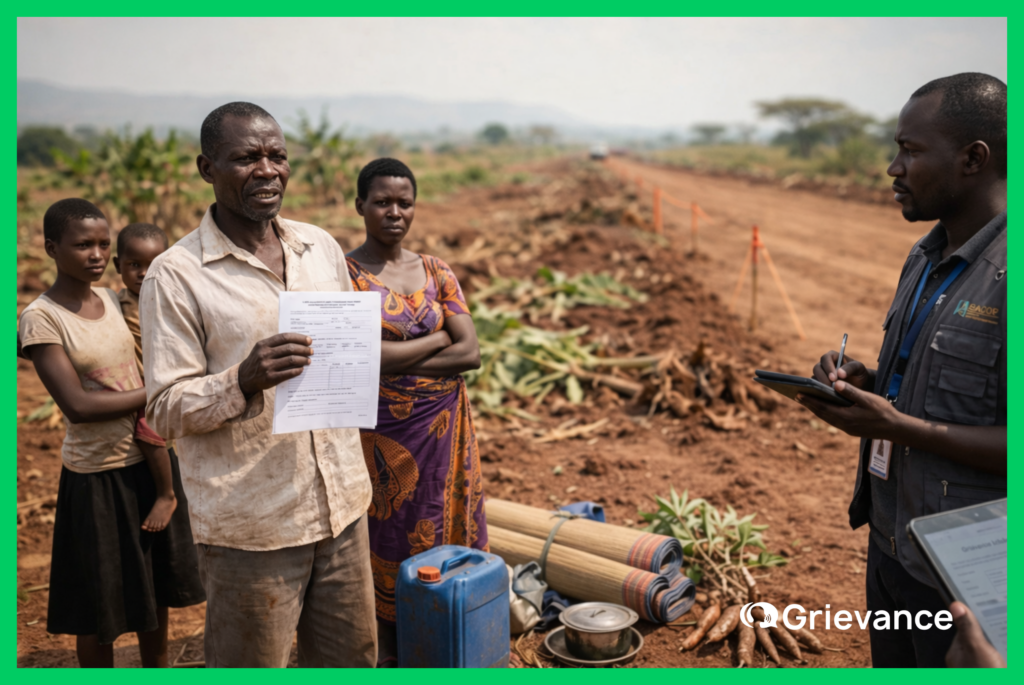
Digital Grievance Redress Mechanism Shields Oil Pipeline Projects in Uganda
Over 100,000 people were directly affected by land acquisition along the East Africa Crude Oil Pipeline corridor, yet fewer than 30% had access to a formal channel to raise concerns. That gap is not a communications failure. It is a risk management failure.
people affected by EACOP land acquisition in Uganda
estimated weekly cost of social-conflict project SHUTDOWN: $13,000
For oil companies operating in Uganda, unresolved community grievances are not a social welfare issue. They are a financial and operational liability. A robust Grievance Redress Mechanism for oil pipeline projects in Africa is now the frontline tool separating projects that stay on schedule from those that don’t.
This article breaks down exactly how a digital GRM works, why Uganda’s oil landscape makes it urgent, and what concrete risk reduction it delivers for projects like Tilenga and EACOP, drawing on IFC Performance Standards and the ESG obligations that now govern international energy financing.
“
A grievance mechanism is not optional for Uganda’s oil sector. The question is whether it is reactive, or strategic.
Risk Management Perspective — EACOP Context
What Is a Grievance Redress Mechanism in Oil and Gas Projects?
A Grievance Redress Mechanism (GRM) is a structured, accessible system that allows affected communities, workers, and third parties to submit complaints, concerns, or disputes related to a project, and receive a documented, timely response. In practice, this means clearly defined intake channels, assignment workflows, response timelines, and resolution tracking. A digital GRM replaces paper registers and informal conversations with a traceable, auditable platform operating continuously, across languages, regions, and communication channels.
Why Uganda’s Oil Sector Faces a Specific Social Risk Profile
Uganda’s oil development is not unfolding in a vacuum. The Tilenga upstream project, operated by TotalEnergies and CNOOC, and the 1,443-kilometre East Africa Crude Oil Pipeline (EACOP) linking Hoima to Tanzania’s Tanga port, represent one of the most complex socio-environmental infrastructure undertakings in Sub-Saharan Africa in decades.
Three Structural Weaknesses Digital Platforms Directly Address
Traditional GRM implementation in oil projects relies on community liaison officers, paper forms, and periodic reporting. This model has three structural weaknesses that a digital platform resolves at the root.
Digital Community Engagement on EACOP: From Paper to Platform
A digital GRM platform resolves each structural weakness mechanically. Communities submit complaints via SMS, USSD, WhatsApp, web forms, or community kiosks in local languages including Luganda, Runyoro, and Swahili. Each submission receives an automatic acknowledgement and a unique tracking reference. The complaint is routed digitally to the responsible team, with escalation triggers if response deadlines are missed.
How a Grievance Redress Mechanism Shields Oil Pipeline Projects: 4 Operational Steps
Early Warning
Geographic clustering
Compliance
Auto-generated reports
Accountability
Zero blind spots
Legal Shield
Timestamped records
Social License to Operate: The Real Cost of Losing It in Uganda
“Social license to operate” is the informal, ongoing acceptance that a project receives from the communities it affects. For oil projects in Uganda, losing that social license has measurable financial consequences. According to the IFC, projects with accessible, responsive grievance mechanisms demonstrate measurably lower social conflict rates and faster regulatory approvals.
| Risk Type | Trigger | Severity | Estimated Impact |
|---|---|---|---|
| Work stoppage | Community blockade of access routes | Critical | $20M+ per week |
| Financing withdrawal | ESG non-compliance finding by IFC/lender | Critical | Project restructuring |
| Regulatory suspension | NEMA enforcement action | High | 6–18 months delay |
| Litigation | Unresolved land compensation dispute | High | Multi-year proceedings |
| Reputational damage | NGO campaign or sustained media coverage | High | Investor confidence & share price |
Communities that receive timely, honest feedback on their grievances remain engaged within the process. Those that don’t, organise outside it. The social license to operate in Uganda is, at its core, a function of information flow, and information flow is exactly what a digital GRM governs.
Implementing a Digital GRM on an Oil Project in Uganda: Key Considerations
Deploying a digital GRM on an active project like Tilenga or EACOP requires more than installing software. It requires a structured rollout that matches the social and logistical reality of the operating environment.
Accessibility by Design
Uganda’s rural connectivity is uneven. A platform that requires smartphone internet access excludes the most vulnerable communities. Effective systems combine USSD codes (accessible on basic feature phones), SMS intake, and WhatsApp channels alongside web-based portals for urban users.
Language and Literacy Sensitivity
Grievance forms and acknowledgement messages must be available in local languages. For projects straddling Uganda and Tanzania, that means at minimum English, Swahili, Luganda, and Runyoro. Voice-based submission options extend accessibility to low-literacy communities.
Community Awareness and Trust-Building
A GRM that communities do not know about, or do not trust, will not receive complaints, it will receive silence, followed by escalation. Deployment must include systematic community sensitisation explaining how the mechanism works, who manages it, and what protection exists against retaliation.
Integration with the ESMS
A digital GRM should feed into the broader Environmental and Social Management System (ESMS) required by IFC standards. Complaint data should link directly to corrective action tracking, stakeholder engagement logs, and ESG reporting dashboards.
International Standards Governing GRM on Uganda Oil Projects
International financing increasingly requires demonstrated, functional grievance mechanisms as a precondition for project approval and continued disbursement. The standards below directly apply to Tilenga and EACOP operations.
- →A digital GRM for oil pipeline projects in Africa is not a compliance checkbox, it is a real-time early warning system and ESG audit trail built into project operations.
- →For Uganda’s oil sector, the scale of EACOP-related displacement and the intensity of IFC and NGO scrutiny make a functional digital GRM among the highest-return risk investments available to operators.
- →Organisations that deploy structured digital GRM systems report a 40–60% reduction in grievance escalation rates within the first year of implementation, according to best practices in extractive industry social management.
- →Accessibility via SMS, USSD, WhatsApp, and voice, is non-negotiable. A GRM that communities cannot reach is not a GRM. It is a liability dressed as a safeguard.
Frequently Asked Questions
Everything you need to know about Grievance Redress Mechanisms for oil pipeline projects in Africa, digital community engagement on EACOP, and ESG compliance for Uganda’s energy sector.
What is a Grievance Redress Mechanism in oil and gas projects?
+
A Grievance Redress Mechanism (GRM) is a formal system allowing communities, workers, and affected parties to submit complaints to a project operator and receive a structured, documented response. In oil and gas, GRMs are required by IFC Performance Standards and function as both a compliance tool and an early warning system for social conflict. Effective GRMs include clear intake channels, defined response timelines, and full traceability from submission to resolution.
How does EACOP manage community grievances in Uganda?
+
The East Africa Crude Oil Pipeline project is required under its Environmental and Social Impact Assessment and IFC standards to maintain a functioning GRM for affected communities along its corridor. In practice, this involves community liaison officers and designated complaint channels. However, civil society organisations including Inclusive Development International have documented significant gaps in responsiveness and accessibility in rural districts making the case for more robust digital systems compelling.
What is a social license to operate and why does it matter for oil projects?
+
A social license to operate is the ongoing, informal acceptance granted by local communities and civil society to a project in their area. Unlike a regulatory permit, it cannot be obtained from a government, it must be earned through consistent, transparent, and responsive engagement. For oil projects in Uganda, losing social license translates directly into access route blockades, project delays, and reputational damage affecting financing and investor relations.
How do digital GRM platforms reduce oil project shutdown risk?
+
Digital GRM platforms reduce shutdown risk by enabling early detection of community tensions before they escalate. Real-time complaint dashboards let project managers identify complaint clusters by location, theme, or frequency. Automated escalation ensures no complaint goes unanswered beyond defined response windows. The result is a systematic reduction in the likelihood that unaddressed grievances evolve into organised opposition or work stoppages.
What IFC Performance Standards apply to grievance mechanisms on oil projects?
+
IFC Performance Standard 1 requires project operators to establish and maintain a grievance mechanism for affected communities that is accessible, transparent, and culturally appropriate. PS5 additionally mandates grievance procedures specifically for displacement-related disputes. Both standards require documented records that can be independently reviewed, making digital platforms the most practical compliance solution for large-scale projects like EACOP and Tilenga.
Deploy a Digital GRM Built for Uganda’s Oil & Pipeline Sector
Grievance App is operational, configurable, and ready to scale across Africa’s energy infrastructure corridors. Multilingual intake, automated escalation, real-time dashboards, fully aligned with IFC PS1, World Bank ESS10, and Equator Principles standards.
Related Reading
Grievance App: Custom GRM Solutions for Complex Multi-Site Operations
World Bank Grievance System Requirements: Why Digital GRMs Are Now Essential