
Digital Grievance Redress Mechanism in Kenya: How NGOs Can Resolve Land Conflicts in Oil, Gas & Infrastructure Project
Use Case: Managing Land-Related Grievances in Kenya
Context: Oil, Gas & Infrastructure Projects
Solution: Grievance App
Land is not simply an economic asset in Kenya; it is identity, legacy, and livelihood. For communities living along infrastructure corridors in the Rift Valley, Turkana County, or the coastal belt of Lamu, a pipeline survey, a road right-of-way, or a compulsory acquisition notice can trigger immediate fear, displacement, and deep-rooted conflict. When those communities have no clear, accessible, and trusted channel to voice their concerns, grievances do not disappear, they escalate, sometimes violently, and almost always at significant cost to project timelines, funder relationships, and organizational reputation.
This is precisely where a well-designed digital grievance redress mechanism in Kenya becomes a strategic asset rather than a compliance checkbox. For NGOs and project implementers navigating Kenya’s complex land tenure landscape, shaped by the Community Land Act 2016, historical marginalization of pastoralist communities, and the heightened scrutiny of international development finance institutions, the ability to capture, track, escalate, and resolve land-related complaints in real time is no longer optional. It is operationally essential.
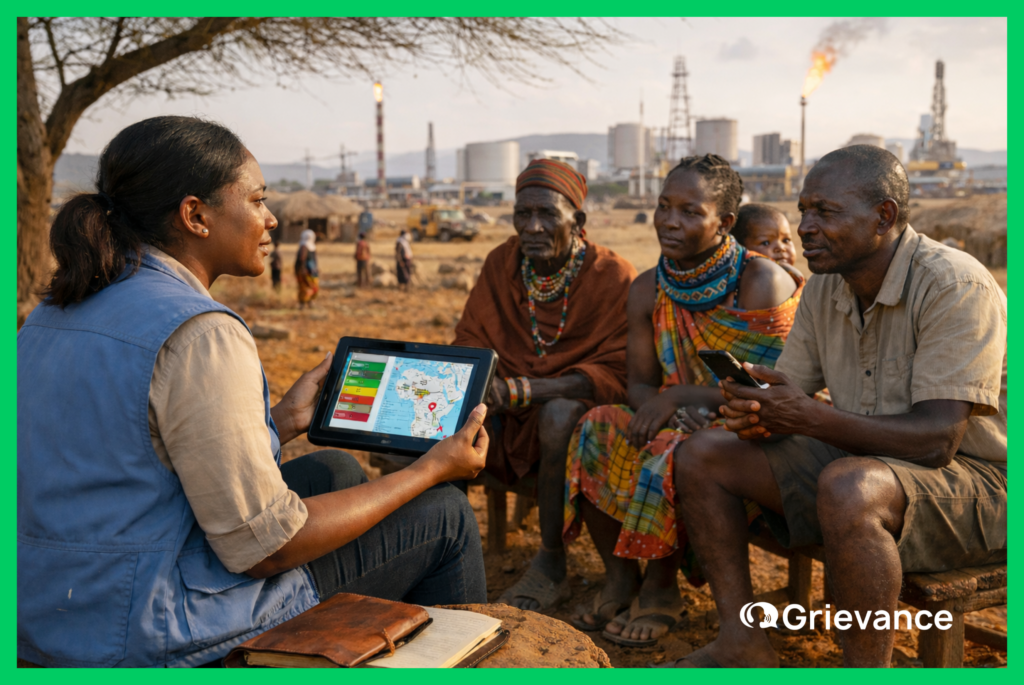
This article presents a hypothetical but carefully grounded use case: an NGO implementing a pipeline infrastructure project in northern Kenya deploys Grievance App to establish a structured digital GRM. Through this scenario, we explore how a purpose-built community complaints management platform transforms the way organizations listen to, engage with, and earn the trust of the communities they serve.
Why Land Grievances in Kenya Demand a Structured Digital Response
A Legal and Social Landscape That Leaves No Room for Informality
Kenya’s land governance framework is among the most legislatively robust in East Africa. The Community Land Act of 2016, the Land Act, and the National Land Policy collectively establish strong procedural rights for communities affected by development projects. At the same time, the IFC Performance Standard 5 on Land Acquisition and Involuntary Resettlement, referenced by virtually every bilateral donor and development finance institution active in Kenya, mandates that project implementers establish accessible, culturally appropriate, and responsive grievance mechanisms before any land-related activity begins.
Yet in practice, most NGOs and infrastructure project managers continue to rely on informal or paper-based complaint systems: suggestion boxes, community meetings with handwritten registers, and email addresses that may or may not be monitored. These systems produce the worst possible outcome, the appearance of accountability without its substance. Complaints are submitted and never acknowledged. Cases are lost between field officers and head offices. Communities interpret silence as indifference. Trust erodes, and latent conflict surfaces.
The Specific Volatility of Land Grievances in Oil, Gas & Infrastructure Projects
Land grievances in resource-extraction and infrastructure contexts differ qualitatively from other complaint types. They are often irreversible in nature; once land is cleared or infrastructure installed, the harm cannot be easily undone. They carry deep emotional weight tied to ancestry and community identity. And they tend to cluster: one unresolved case generates three more as neighboring community members observe the outcome and calibrate their own expectations accordingly.
In Kenya’s northern counties, Turkana, Marsabit, and Isiolo, where pastoral land rights are communally held, often undocumented, and subject to competing interpretations under both statutory and customary law, the risk of mismanagement is compounded. Without a land grievance management system capable of handling complex, multi-party, and multi-site cases simultaneously, organizations operating in these regions are perpetually exposed.
Hypothetical Use Case: Grievance App in a Northern Kenya Pipeline Project
Project Scenario and Context
Imagine a mid-sized international NGO, let us call it BuildRight East Africa, contracted to manage community liaison and social safeguards for a 420-kilometer oil pipeline project crossing three counties in northern Kenya. The project affects an estimated 14,000 community members across 62 villages. Land-use disruption, compensation delays, and restricted access to traditional water sources become immediate sources of tension within the first month of construction.
BuildRight East Africa had previously managed grievances through paper registers and bimonthly community meetings. Within eight weeks of project commencement, the backlog of unresolved complaints had reached over 200 cases. Field staff were overwhelmed, donors were requesting structured reporting they could not produce, and two community leaders had already contacted an advocacy NGO in Nairobi.
At this inflection point, BuildRight East Africa deploys Grievance App as its central digital grievance redress mechanism.
How Grievance App Structures the Full Complaint Lifecycle
The deployment unfolds in four phases, each corresponding to a critical capability of the platform:
- Multi-Channel Intake: Community members submit land-related complaints via mobile app (Android/iOS), SMS shortcode, or through community liaison officers using an offline-enabled tablet interface. All submissions are automatically timestamped, geo-tagged where possible, and assigned a unique tracking reference. Anonymous submission is enabled by default, critical in contexts where community members fear retaliation from project contractors.
- Intelligent Categorization & Routing: Each complaint is automatically classified by type (land acquisition, compensation dispute, environmental damage, access restriction), assigned a priority level, and routed to the responsible case officer. Related cases, for instance, 17 separate complaints about the same water source, are flagged for potential consolidation, reducing redundancy and ensuring systemic issues are visible to management rather than fragmented across individual cases.
- Structured Investigation & Escalation: Case officers document investigation steps, evidence, and proposed resolutions directly within the platform. When a case remains unresolved beyond a pre-configured SLA threshold (typically 15 business days for land cases), the system automatically escalates to the Senior Safeguards Manager and sends a notification to the community member. This single feature, automated escalation, eliminates the most common failure point in paper-based GRMs: cases that fall through the cracks because no one noticed the deadline had passed.
- Resolution, Closure & Feedback Loop: Once a resolution is reached, the community member receives formal notification in Swahili, Turkana, or English, depending on their declared preference, outlining the outcome and the rationale. They are invited to confirm satisfaction or reopen the case. This closed-loop process, rarely possible in analog systems, is the foundation of measurable community trust.
A Digital GRM That Speaks the Language of Donors and Development Standards
BuildRight East Africa’s program director needs to demonstrate to her principal funder, a European development finance institution, that the GRM meets IFC PS5 requirements and the Equator Principles. With Grievance App, she can generate a structured GRM performance report in minutes: total complaints received, categorized by type and county; average resolution time; escalation rate; community satisfaction scores; and proportion of cases involving land-related issues.
This is land grievance management in oil and gas infrastructure in Africa at its most mature: transparent, traceable, and fully defensible to any external audit. The report meets the accountability standards set by organizations such as the World Bank Environmental and Social Framework (ESF10) and bilateral donors, including the Agence Française de Développement (AFD).
Key Outcomes: From Complaint Backlog to Community Confidence
Hypothetical Results After 6 Months of Deployment, illustrative figures based on comparable GRM implementations in Sub-Saharan Africa:
- 94% of land-related complaints acknowledged within 48 hours (vs. under 30% with the paper system)
- 78% of cases resolved within the defined SLA window
- Complaint backlog reduced from 200+ cases to under 40 within the first 90 days
- 3 systemic land issues identified through case clustering and addressed at the policy level
- GRM performance report generated and submitted to the donor within 2 hours of the request
Beyond the numbers, the qualitative shift is equally significant. Community liaison officers report that village leaders, previously hostile to project staff, have become constructive interlocutors. The knowledge that a complaint will be acknowledged, tracked, and responded to within a defined timeframe changes the psychological dynamic of community engagement fundamentally.
Why Purpose-Built Community Complaints Management Software Makes the Difference
Not All Software Is Built for Development Contexts
Generic helpdesk tools, Zendesk, Freshdesk, and ServiceNow, are engineered for commercial customer service environments. They lack the features that define effective community complaints management software in development contexts: anonymous intake, multilingual interface, offline data capture in low-connectivity environments, role-based access for field officers and headquarters staff, IFC-aligned reporting templates, and culturally sensitive escalation logic.
Grievance App is built specifically for these requirements. Its configurable dashboard allows program managers to monitor grievance trends by category, geography, and resolution status in real time. Its role-based access control ensures that sensitive case information, including the identity of complainants who have not opted for anonymity, is protected in compliance with data protection frameworks, including Kenya’s Data Protection Act 2019.
Designed for the Digital Grievance Redress Mechanism Needs of NGOs in Kenya and Beyond
For NGOs operating across East Africa, the platform’s multilingual capability, supporting English, Kiswahili, French, Arabic, and a growing list of local languages, is not a convenience feature. It is a safeguard against the exclusion of the most vulnerable community members from the grievance process. A complaint mechanism that functions only in English in Turkana County is not, in practice, accessible.
Similarly, the platform’s API-based integration capability means that organizations can connect Grievance App to their existing project management tools, monitoring and evaluation systems, or donor reporting portals, creating a seamless data flow rather than a siloed reporting burden. This interoperability is increasingly expected by development finance institutions and bilateral donors that require standardized social safeguards data.
Building Community Trust Is a Strategic Investment, Not a Compliance Cost
The most enduring lesson from land grievance management in oil, gas, and infrastructure projects across Africa is that community trust is not built in a single interaction; it is accumulated through hundreds of small, reliable, responsive acts of accountability over months and years. Every complaint is acknowledged promptly. Every case was resolved transparently. Every community member who hears back in their own language.
Organizations that invest in a robust digital GRM do not simply reduce their legal and reputational exposure; they build the social capital that enables projects to be completed on schedule, renewed, and expanded. In an environment where project delays attributable to community opposition cost an estimated USD 10,000 per day for mid-scale infrastructure projects, the return on investment of a well-implemented digital grievance system is both measurable and significant.
For a deeper understanding of how GRM design choices affect community outcomes, explore our related resources on GRM implementation best practices and IFC-aligned grievance mechanism design.
Ready to Transform Your Land Grievance Management?
Grievance App helps NGOs, infrastructure developers, and development finance partners across Kenya and Sub-Saharan Africa establish fully digital, IFC-compliant, and community-trusted grievance redress mechanisms in weeks, not months.
Whether you’re managing a pipeline project in Turkana, a road corridor in the Rift Valley, or a multi-site program across East Africa, our team will walk you through a tailored solution built for your operational context.
Conclusion
Land-related grievances in Kenya’s oil, gas, and infrastructure projects are not a peripheral risk; they sit at the heart of project viability, donor compliance, and organizational credibility. The communities most affected by these projects deserve more than a suggestion box and a quarterly meeting. They deserve a responsive, transparent, and accessible mechanism that treats their concerns as legitimate, tracks every case to resolution, and reports outcomes honestly.
A digital grievance redress mechanism built on a platform like Grievance App does not eliminate conflict; no technology can. But it provides the structure, the speed, and the accountability that transforms how organizations respond to conflict: moving from reactive damage control to proactive trust-building.
For NGOs and project implementers operating in Kenya’s high-stakes land environments, that shift is not just ethically right. It is strategically decisive.
FAQ — Frequently Asked Questions
What is a digital grievance redress mechanism (GRM) in the context of infrastructure projects in Kenya?
A digital grievance redress mechanism (GRM) in Kenya is a structured, technology-enabled system that allows affected community members to formally submit, track, and receive responses to their complaints related to infrastructure or development projects. Unlike paper-based systems, a digital GRM ensures every complaint is recorded, assigned, escalated if necessary, and resolved within defined timeframes, providing both accountability to communities and audit-ready documentation for donors and regulators.
Why is land grievance management particularly critical in oil, gas, and infrastructure projects in Africa?
Land grievances in oil, gas, and infrastructure projects in Africa carry unique complexity: they involve irreversible land-use changes, communal and customary land rights that may not be formally documented, and communities with limited access to legal recourse. Without structured land grievance management, disputes escalate rapidly into project delays, reputational damage, and social conflict. Effective GRM systems aligned with IFC Performance Standard 5 and the Equator Principles are increasingly mandated by development finance institutions as a precondition for project funding.
What features should community complaints management software include for NGOs in development contexts?
Effective community complaints management software for NGOs should include: anonymous and multilingual complaint intake (covering local languages such as Kiswahili, Turkana, or Somali in Kenya); offline data capture for low-connectivity field environments; automated acknowledgment, SLA tracking, and escalation workflows; role-based access control to protect complainant confidentiality; IFC/ESF-aligned reporting templates; and API integration with existing project management or M&E systems. Generic helpdesk tools typically lack these capabilities.
How does a digital GRM help NGOs meet IFC Performance Standard 5 requirements in Kenya?
IFC Performance Standard 5 requires project implementers to establish a grievance mechanism that is accessible, responsive, and culturally appropriate before any land acquisition or resettlement activity. A digital GRM, such as Grievance App, directly supports PS5 compliance by providing documented evidence of: complaint intake and acknowledgment; investigation timelines; escalation protocols; resolution outcomes; and community satisfaction feedback, all of which are required in periodic social safeguards reporting to lenders and donors.
Can a digital grievance redress mechanism be deployed effectively in remote areas of Kenya with limited internet connectivity?
Yes. Leading community complaints management software platforms, including Grievance App, are designed with offline-first functionality for field deployment in low-connectivity environments. Field officers can log, categorize, and document complaints on mobile devices without internet access; data synchronizes automatically when connectivity is restored. SMS-based intake channels further extend accessibility to community members who lack smartphones, essential in remote counties such as Turkana, Marsabit, or West Pokot.
This article presents a hypothetical use case for illustrative purposes. All figures and scenario details are constructed to reflect plausible real-world conditions based on comparable GRM implementations in Sub-Saharan Africa. References to legislation and international standards reflect publicly available frameworks.