
Use Case: Community Feedback Mechanisms in Disaster Recovery Projects in the Philippines
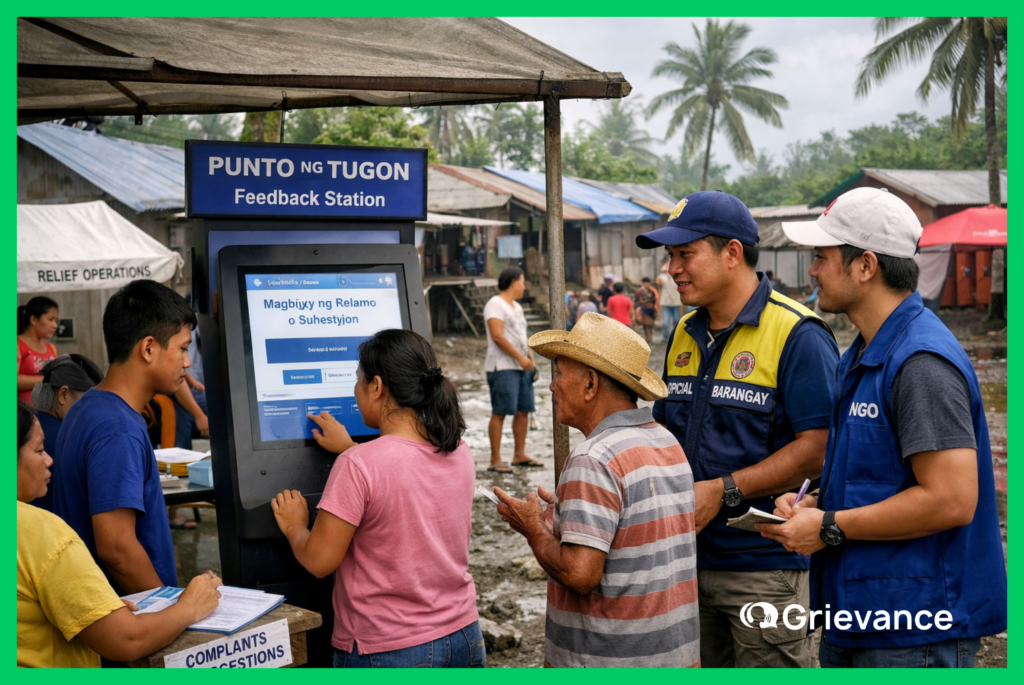
Natural disasters are a constant threat in the Philippines, one of the world’s most disaster‑prone countries. Typhoons, floods and earthquakes strike regularly, affecting millions and overwhelming local capacities. Yet in many recovery efforts, communities often lack structured channels to voice needs and complaints. Studies of the 2013 Typhoon Haiyan (Yolanda) response found that “active community participation was undeniably missing” in relief planning and accountability.
Without robust community feedback mechanisms, urgent concerns go unreported and aid can miss its mark. Unmet needs, social tensions and eroded trust in humanitarian actors frequently result. Embedding effective community feedback mechanisms in disaster recovery is therefore critical; it ensures that affected people are heard, helps direct resources where they’re needed, and upholds accountability.
For example, a survey after Typhoon Haiyan revealed that many survivors did not know how to submit complaints or requests, so agencies had to create new guidance to inform communities about feedback processes. Similarly, research in the region shows people strongly prefer face-to-face dialogue over impersonal hotlines. These findings highlight that simply making information available isn’t enough, recovery programs need accessible, trusted channels that genuinely connect with local cultures and practices.
- The Philippines’ high disaster exposure (ranked #1 by 2025 World Risk Index) and well‑developed disaster laws set the stage, but recovery is still hampered by weak feedback loops.
- In Haiyan’s aftermath, aid agencies used many communication channels (hotlines, SMS, bulletin boards), yet community surveys found these were often “one-way” and failed to change major decisions.
- Common consequences of poor feedback include delays in aid delivery, misallocation of resources, and loss of trust between communities and responders. As one expert noted, unattended complaints can “erode the community’s trust” and eventually spiral into conflict.
These challenges underscore the need for a modern, digital grievance redress mechanism that captures citizen feedback in real time and makes humanitarian responses more responsive and accountable.
Barriers to Capturing Community Feedback
Building effective feedback loops in Philippine disaster recovery faces several obstacles. A major issue is awareness and accessibility: affected people often don’t know how to give feedback or lack easy ways to do so. For example, an assessment found that after disasters, people had “insufficient aid‑related information” and lacked a voice in decision-making. Complaint systems existed on paper, but without clear outreach or trust, many grumbled privately instead of reporting them.
Cultural factors also play a role. Filipinos tend to favor personal, respectful communication; surveys after Haiyan showed communities “overwhelmingly preferred face-to-face communication” because it allows genuine dialogue. By contrast, SMS hotlines and other digital tools were viewed skeptically if people didn’t already have a relationship with the agency. This means that any feedback tool must complement, not replace, community meetings and local networks.
Institutional hurdles further limit feedback: many local government units and NGOs lack dedicated accountability staff or funding for feedback outreach. During Haiyan, overlapping mandates and siloed systems meant there was “no effective mechanism to challenge local officials” or ensure they delivered on promises. In practice, this left communities reluctant to speak up. As one report notes, transparent information alone isn’t enough; it must be tied to actionable accountability, so people feel their input truly matters.
Taken together, these barriers lead to lost opportunities. When surveys show a community’s top concern (e.g., new latrine, water project) but agencies aren’t listening, aid is misdirected. Conversely, a trusted feedback loop can prompt small course corrections (adding a livelihood program, shifting relief packages) with huge impact. The goal, then, is to overcome these barriers with digital grievance redress mechanisms that are accessible, user-friendly, and integrated with local practices.
Digital Grievance Redress Mechanisms for Disaster Response
Digital platforms are revolutionizing how humanitarian actors gather community feedback. A well-designed Digital Grievance Redress Mechanism (GRM) connects affected people to aid providers via multiple channels, web, mobile apps, SMS, hotlines, or on‑site touchpoints, breaking down geographic and logistical barriers. For example, digital platforms can allow survivors to submit complaints “from anywhere at any time” (day or night, in or out of shelters). This ensures that even people in remote or confined areas (like evacuation centers) have a voice. And because the interface can be multilingual, people can file feedback in Tagalog, Cebuano, or other native languages, with automated translation on the back end.
Modern GRM platforms also bring real-time tracking and transparency. Every submission is logged with timestamps and unique IDs, creating an audit trail. Dashboards show staff the status of each case at a glance. Automated alerts remind teams to respond within target timelines, and escalation rules can push neglected cases up the chain. In practice, this means no complaint “falls into the cracks”; communities see that agencies are actively monitoring issues. The transparency of digital logs builds trust: when people can watch their complaint move from “received” to “in process” to “resolved,” they know they’re being heard.
Importantly, digital GRMs enable data-driven insights. By aggregating feedback entries, the system can identify patterns (e.g., many reports of broken pumps or missing relief kits) and flag systemic issues. Decision-makers can then reallocate resources or adjust programs based on real community input. As one Grievance App white paper notes, complaint data often reveals “patterns and systemic issues” that might otherwise go unnoticed. This analytic capability turns scattered comments into actionable intelligence, a powerful learning loop that sharpens recovery efforts.
Practically speaking, an effective digital GRM should offer:
- Multi-Channel Input: Mobile-friendly web forms, SMS short codes, call-center hotline, and on-site kiosks ensure all demographics can report feedback. For instance, adding an SMS hotline allows even non-smartphone users to send feedback from basic phones.
- Anonymous & Inclusive: Complainants can choose anonymity if worried, and the system supports multiple languages or voice submission (for illiterate users).
- Real-Time Management: Staff dashboards display incoming feedback instantly. Automated notifications, reminders, and escalations (see Grievance App’s workflow features) speed up response times.
- Categorization & Reporting: Each feedback is tagged (by location, issue type, severity). Custom reports and maps highlight hotspots of need.
- Security & Compliance: Strong user access controls and data protection (GDPR, bank ESS10) safeguard sensitive data. Every action is logged for audit purposes.
These features collectively address the barriers above: digital tools extend reach beyond face-to-face, maintain transparency, and make it easier for overwhelmed agencies to handle large volumes of feedback efficiently.
Integrating with Humanitarian Accountability
Building a digital GRM isn’t just good practice; it’s increasingly a requirement in modern humanitarian work. International standards like the Core Humanitarian Standard (CHS) explicitly call for feedback and complaint channels as key to quality programming. In fact, experts emphasize that agencies should “collaborate on collective tools like feedback mechanisms” to meet CHS commitments. Similarly, major donors (the World Bank, ADB, UN agencies) now mandate robust GRMs (for example, World Bank’s ESS10 on Stakeholder Engagement).
A shared digital platform can even enhance coordination: instead of each NGO running separate hotlines, a common system or interoperable apps allow data-sharing and joint analysis. During Typhoon Haiyan, agencies noted the chaos of overlapping efforts; today, a unified digital approach could prevent that. For example, joint initiatives like the Pamati Kita consortium have begun pooling community feedback for regional coordination. A country-wide framework could further require that local DRRM units, disaster councils, and NGOs feed community inputs into one dashboard, ensuring that every voice, from barangay to city hall, is integrated.
Ultimately, a digital GRM turns transparency into accountability. As one synthesis report starkly concluded: “It is not enough to be transparent. What is crucial is how people can use information to make the power holders aware of what should be done and enforce actions.” By enabling feedback to flow both ways, technology helps hold agencies and officials accountable to affected people, a cornerstone of humanitarian effectiveness.
Case Study: Feedback in Action (Philippine Recovery Scenario)
Consider a hypothetical scenario in post-typhoon reconstruction. In late 20XX, Typhoon Ursula slams Eastern Visayas. In response, a coalition of NGOs and local government deploys Grievance App’s digital GRM as a pilot in the hardest-hit districts. The app’s multi-channel platform, accessible via mobile app, SMS code, and a staffed call center, allows survivors to submit concerns in Tagalog or Bisaya around the clock. Within days, hundreds of reports pour in: villagers flag damaged irrigation pumps, requests for water filtration kits, and complaints about being left off distribution lists.
All feedback is immediately visible to the Relief Coordination Unit. They see trends on a dashboard and assign each issue to appropriate teams: e.g., “Supply Delivery Team: Replace 100 water filters in barangay X,” or “Engineering Team: inspect damaged bridge in town Y.” Automated reminders ensure no item is forgotten. Within two weeks, many problems are addressed: relief packages are rerouted to newly identified areas of greatest need, broken community wells are repaired, and miscommunication issues (like wrong beneficiary lists) are corrected. Crucially, authorities post updates back to the community through the same channels, closing the feedback loop: every submitter receives an SMS or call update when their concern is resolved.
This example illustrates the power of digital feedback: an accessible system amplified local voices and guided recovery resources where they mattered most. According to field surveys, communities given such transparent feedback channels experience greater trust and cooperation. In our scenario, villagers who felt heard by prompt action were more likely to engage positively with aid workers. Over the project’s six-month timeline, the use of the GRM led to measurable improvements: response times to urgent issues shrank by half, and overall beneficiary satisfaction ratings rose significantly (as post-project interviews would likely confirm).
Grievance App: A Digital GRM for Humanitarian Accountability
Grievance App is a leading example of a digital GRM platform built for exactly these contexts. Designed for high-impact projects, it encapsulates best practices in feedback management:
- Multi-channel Intake: The platform supports anonymous, multilingual complaint submission via web portal, mobile apps, and SMS. Even in areas with intermittent internet, people can dial a number or send a text. The intuitive interface (with voice/touch options) ensures inclusivity.
- Real-Time Case Management: Every complaint is timestamped and entered into a live tracking dashboard. Staff and managers see the status of each case (new, in progress, escalated, resolved) at a glance. Custom notifications and automatic escalations (e.g., if a case is unresolved past SLA) ensure swift follow-up.
- Structured Processing: Grievances are classified by tags (e.g., water, shelter, health) and priority level, so clusters of related issues are identified. AI-driven suggestions (based on past data) can even recommend likely solutions or route cases to specific teams. Bulk actions (assigning, closing, commenting) let users handle large batches efficiently.
- Secure, Compliant & Auditable: User roles and permissions control who sees or edits cases. Advanced security and encryption protect sensitive information. A full audit trail logs every user action and change, ensuring compliance with international standards (World Bank ESS10, GDPR, etc.) and donor SLAs.
- Customizable & Accessible: Grievance App’s interface can be branded and localized. It is fully responsive on smartphones, tablets, and computers. Accessibility features like high-contrast mode and voice prompts widen usability. It also offers API integration, so data can flow to other systems (e.g., GIS maps, ERP databases).
By implementing these features, Grievance App turns abstract accountability into tangible outcomes. Agencies using it report higher efficiency in complaint handling and stronger stakeholder trust. As one field report notes, an effective grievance system can prevent minor grievances from snowballing and “build trust by showing that their voices matter”. In other words, communities see that their input directly influences project decisions.
Key benefits in disaster recovery include:
- Transparency & Trust: Communities can track progress on their complaints. Visible logs and consistent follow-through (closing the loop) reinforce credibility. Studies show that when grievances are addressed proactively, tension and conflict quickly diminish.
- Operational Efficiency: Automated workflows and dashboards save staff time. The Relief Coordination Unit no longer chases missing papers or duplicate reports: everything is centralized and sorted. This means faster resolutions, for example, a broken water pump report in 2021 was resolved in days rather than weeks.
- Data-Driven Decisions: Aggregated feedback reveals systemic issues early. If 100 flood victims report blocked roads, managers can shift resources to repair efforts before problems spiral. Over time, analysis of grievance trends informs better preparedness (e.g., stocking more supplies in frequently impacted areas).
- Accountability to Donors & Communities: International standards and donors expect robust AAP (Accountability to Affected Populations). Using Grievance App demonstrates compliance: reports and logs can be shared with funders or auditors. It also shows communities that agencies are serious about listening, which improves relationships and program legitimacy.
For more on implementing such solutions, see our blog post on proactive grievance strategy and how digital platforms transform GRMs on the Grievance App website. These resources explain why early stakeholder engagement and transparency are at the core of successful GRMs.
Conclusion
In the Philippines’ fast-changing humanitarian landscape, community feedback is not a luxury; it’s a lifeline. Disaster recovery projects that harness community feedback mechanisms in disaster recovery become inherently more adaptive, effective, and equitable. A well-implemented digital GRM like Grievance App empowers disaster-affected people to be active participants, not just recipients, of aid. It closes the loop between communities, NGOs, and authorities, ensuring concerns trigger action and lessons feed future planning.
As the 2025 WorldRiskReport reminds us, disasters here will keep coming. The question isn’t if we need community feedback mechanisms, but how fast we can deploy them. By leveraging technology, humanitarian actors can amplify the voice of every survivor and uphold the highest standards of accountability.
To experience this in your own projects, request your free demo of Grievance App’s solution and see firsthand how it makes every voice count.
Frequently Asked Questions
What are community feedback mechanisms, and why are they important in disaster recovery?
Community feedback mechanisms are structured channels (like hotlines, surveys, or grievance platforms) that let affected people express needs, complaints, or suggestions during recovery. In disaster recovery, they are crucial for ensuring aid is relevant and timely. Effective feedback loops make programs more inclusive and help agencies adapt to real community priorities. They also build trust, since people see their input taken seriously.
How does a digital grievance redress mechanism improve disaster response?
A digital grievance mechanism (GRM) uses technology to collect and manage complaints (via web, SMS, apps, etc.). This makes it far more accessible; for example, villagers can report issues from anywhere, at any time. Digital tools provide real-time tracking and analytics, so agencies can see emerging needs and respond quickly. Automation (acknowledgements, status updates) keeps the community informed. Overall, digitization boosts efficiency, transparency, and accountability compared to paper or ad-hoc systems.