
World Bank Grievance Redress Mechanism: Ensuring Accountability and Trust in Projects
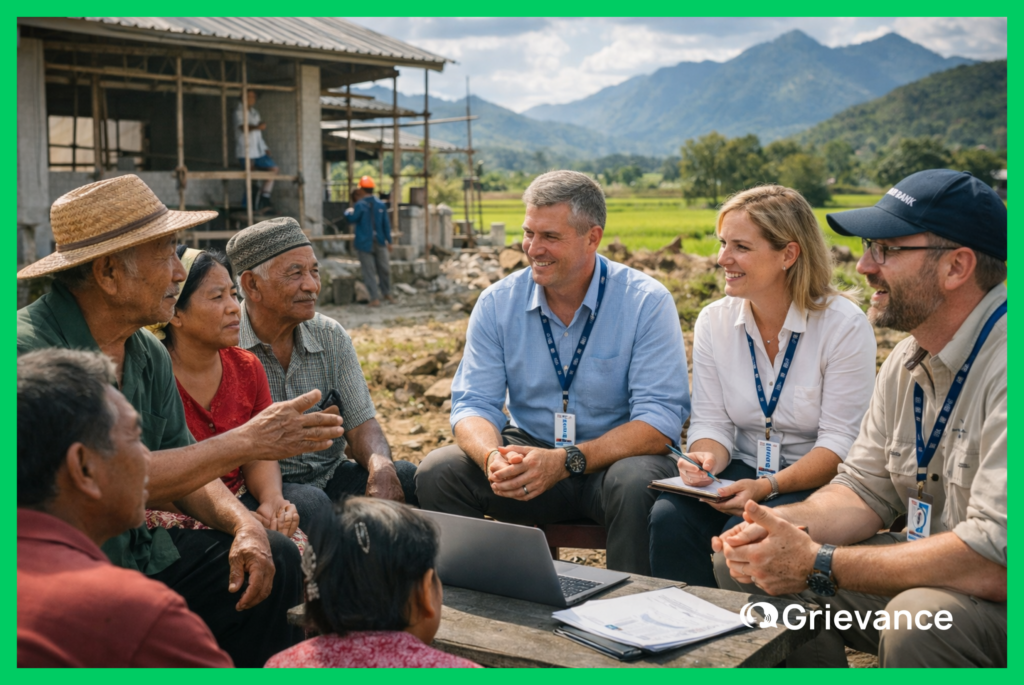
In World Bank–funded projects, a robust Grievance Redress Mechanism (GRM) is more than a bureaucratic checkbox; it’s a lifeline for community trust and project success. When local concerns and complaints go unheard, they can fester into serious problems: minor issues like dust or noise can spark protests, costly delays, or even project suspension. The World Bank Grievance Redress Mechanism provides a structured way for stakeholders to voice concerns and obtain redress before conflicts escalate.
By handling complaints transparently and efficiently, a GRM turns potential flashpoints into opportunities for dialogue and improvement. It’s no surprise that international donors mandate effective GRMs in projects with significant social or environmental impacts. In short, an effective grievance mechanism isn’t just about compliance; it’s a strategic tool to uphold accountability, protect communities, and keep development projects on track.
Understanding the World Bank Grievance Redress Mechanism (GRM)
A grievance redress mechanism in a World Bank project is a formal process for receiving, evaluating, and resolving complaints from project-affected people. It ensures that anyone impacted by a project, local residents, workers, or other stakeholders, has an accessible channel to voice concerns (for example, about construction impacts, resettlement, environmental harm, or worker issues) and to receive a prompt, fair response. The goal is to resolve problems early and at the project level, rather than letting them intensify or be pushed up to courts or the Bank’s independent panels. According to the World Bank’s own guidance, an effective GRM “provides project-affected parties with redress and helps address issues at an early stage”.
In practice, a World Bank GRM typically includes multiple intake channels (like community hotlines, complaint boxes, email/web portals, or in-person offices), clear procedures for reviewing and investigating issues, and timelines for feedback and resolution. The mechanism should be independent and responsive, and complainants must feel safe using it and confident that their issues will be objectively addressed. Transparency is key: each grievance is logged and tracked, and stakeholders are kept informed of progress. Ultimately, the World Bank GRM acts as a bridge between project implementers and the community, ensuring that voices are heard and problems are solved in a way that builds trust.
Why Grievance Mechanisms Matter in World Bank–Funded Projects
Establishing a grievance redress mechanism in World Bank–funded projects is not just about resolving individual complaints; it’s about reinforcing the project’s social license to operate. These mechanisms serve several critical purposes:
- Early Risk Detection: A well-implemented GRM functions as an early-warning system. Project supervisors can spot patterns in complaints (for example, multiple reports of dust pollution or delayed compensation) and address them before they escalate into larger conflicts. In this way, grievances become valuable feedback, highlighting issues that management might otherwise overlook. As one World Bank oversight team noted, unresolved grievances that are ignored often balloon into protests or even violence, whereas a good GRM “nips disputes in the bud” through prompt resolution.
- Conflict Prevention and Trust-Building: When community members see their complaints taken seriously, it builds goodwill. Each resolved grievance is an opportunity for the project to demonstrate accountability and respect. Over time, this turns potential adversaries into partners. Communities that might initially be sceptical of a project become more supportive when they have a say and see concrete responses to their concerns. Conversely, if people feel ignored, resentment grows. A transparent GRM shows stakeholders that the project values their input, greatly reducing the likelihood of unrest. Indeed, development projects with strong grievance systems tend to have fewer public protests, fewer work stoppages, and a better reputation in the community. In short, handling complaints proactively helps safeguard the project’s progress and credibility.
- Accountability and Good Governance: From an oversight perspective, the GRM is a cornerstone of good project governance. It creates a formal record of issues raised and how they were resolved, which is crucial for audits and supervision missions. World Bank project teams and government implementing agencies alike use GRM data to demonstrate they are responding to public feedback. This level of accountability can protect projects from allegations of negligence. It also puts real metrics behind concepts of transparency and participation; for example, a project can report how many grievances were received and resolved within the target timeframe. Internally, this holds project staff accountable to high service standards, and externally, it reassures donors and communities that the project is being managed responsibly.
In essence, grievance mechanisms turn complaints into a constructive force. Rather than viewing community grievances as a threat, World Bank projects now recognise them as critical feedback. Addressing these issues early not only prevents conflict but often leads to improvements in project implementation (for example, redesigning a resettlement plan or adding safety measures after community input).
Especially in projects with a big social or environmental footprint, a GRM is vital for maintaining stakeholder trust and keeping development objectives on track.
World Bank Safeguards and ESS10: Grievance Mechanism Requirements
The importance of grievance redress in World Bank projects stems from its safeguard policies. Under the Environmental and Social Framework (ESF), Environmental and Social Standard 10 (ESS10) mandates a project-specific grievance mechanism for all projects with moderate to high environmental or social risks. Without a GRM, major projects cannot receive Bank funding. ESS10 expands earlier safeguard requirements to cover all stakeholders, making grievance mechanisms central to project design and approval.
ESS10 sets clear standards: grievance systems must be accessible, inclusive, and proportionate to project risks. They should offer multiple entry points, hotlines, SMS, email, local offices, and be open to all, including vulnerable groups. Common principles include:
-
Inclusivity: GRMs must be culturally appropriate and accessible to everyone, with language support and disability accommodations.
-
No Cost & No Retaliation: Filing a complaint should be free and safe, with options for anonymity to protect against backlash.
-
Transparency & Fairness: Procedures must be clear, with timelines, documentation, and appeal options. The GRM complements, but doesn’t replace, legal remedies.
-
Timely Response: Projects should address complaints quickly, often within 2–4 weeks. The Bank monitors compliance with response benchmarks.
Non-compliance can delay funding. Conversely, an effective GRM demonstrates accountability and helps meet donor requirements. That’s why more borrowers are turning to digital solutions to log grievances, track resolutions, and prove real-time alignment with ESS10.
Best Practices for an Effective Grievance Redress Mechanism
Designing an effective grievance redress mechanism (GRM) requires a focus on accessibility, responsiveness, and transparency. Below are best practices inspired by ESS10 and real project success stories:
-
Accessibility & Inclusiveness: Ensure the GRM is open to all, offering multiple channels, hotlines, SMS, online forms, and local offices in local languages and at no cost. Include options for anonymous complaints to protect vulnerable users and encourage honest feedback.
-
Clear Procedures & Timely Response: Define a structured workflow with clear roles and deadlines. Acknowledge complaints promptly and aim to resolve them within set timeframes. Establish escalation paths for unresolved or sensitive cases to maintain trust and fairness.
-
Transparency & Communication: Keep complainants informed through tracking numbers, status updates, and simple language. Share summary data (e.g., resolution rates) via reports or public platforms to build community confidence in the process.
-
Documentation & Accountability: Log each grievance with details like date, category, and resolution. A centralised register supports audits, identifies recurring issues, and demonstrates accountability to stakeholders.
-
Continuous Improvement: Regularly analyse grievances to detect patterns and adjust operations. Solicit feedback on the process itself to improve user experience and system fairness. A GRM should evolve with the project and serve as a learning tool.
By applying these principles, teams show their commitment to stakeholder engagement. A well-run GRM reduces conflict, boosts outcomes, and enhances project credibility through structured, transparent dialogue.
Case Study: World Bank Grievance Mechanism Success in Sierra Leone
Real-world examples illustrate how a strong grievance mechanism can dramatically improve project outcomes. In Sierra Leone, the World Bank–funded initiatives in the energy and urban sectors have become success stories for GRM implementation. The country’s Electricity Distribution and Supply Authority (EDSA), under a World Bank energy project, deployed a digital grievance portal accessible 24/7. Citizens could submit complaints via multiple channels, a toll-free hotline, SMS, a mobile app, or an online form in several languages.
Each grievance was automatically logged with a timestamp and tracked through to resolution, with dedicated staff monitoring the dashboard. The results were striking: customer satisfaction surged and resolution times plummeted. In fact, the project achieved a resolution rate above 99% for high-priority cases, thanks to automated routing of complaints to the right departments and instant escalation of overdue issues. With clear status updates and public dashboards showing the number of issues resolved, EDSA was able to demonstrate to communities that every case was addressed promptly, significantly increasing public trust.
Key outcomes from Sierra Leone’s digital GRM:
- Faster Resolutions: The automated workflow (routing and alert system) cut down delays. The project resolved over 99% of priority grievances, as urgent cases were immediately flagged and dealt with.
- Transparency & Trust: Every complaint received a unique ticket number and expected timeline, and complainants could see updates. This visibility reassured communities that issues weren’t being swept under the rug. The openness of the process built trust, as people saw proof that “every case was addressed” and taken seriously.
- Efficient Management: A unified database consolidated all grievances from different channels. This avoided duplication and lost reports. Managers could spot systemic issues at a glance and generate reports to share with World Bank donors and government oversight bodies. The data-driven approach meant recurring problems (for example, frequent electricity outages in a particular district) were identified and addressed beyond just the individual complaints.
Another example comes from the World Bank’s Resilient Urban Sierra Leone Project (RUSLP), which similarly implemented a multi-channel GRM for city services. Residents could report issues like waste collection delays or infrastructure problems through an app, hotline, or local centres. By integrating this GRM into municipal operations and training local staff, the project ensured sustainability beyond the World Bank’s involvement. The impact was clear: city authorities responded faster to community concerns, public confidence increased, and small disputes were resolved before turning into big public complaints. In one instance, community tension over a delayed construction project was defused because citizens saw their grievances logged and heard back on mitigation measures, a stark contrast to the old days of silence.
These case studies highlight that when a grievance mechanism is done right, it transforms the relationship between projects and communities. Instead of complaints “slipping through the cracks,” they become inputs for better project management. Sierra Leone’s experience shows that digital GRMs in particular can supercharge this process: not only achieving extremely high resolution rates, but also providing the transparency that is essential for trust-building.
In fact, across several African projects (including those funded by the World Bank), digital platforms have delivered resolution rates above 99% for timely cases, while preventing conflicts by giving communities a clear voice and prompt redress. The lesson is powerful: a robust GRM can turn would-be adversaries into partners, and convert daily complaints into a foundation for continuous improvement and mutual trust.
Leveraging Technology: Digital Solutions for GRM Success
Applying GRM best practices manually is difficult in large-scale projects. That’s why many organisations adopt digital grievance platforms like Grievance App, which offer scalable, efficient, and transparent solutions aligned with World Bank ESS10 standards.
A digital GRM centralises all core features:
- Multi-Channel Intake: Grievances can be submitted via web, mobile, SMS, email, or even social media, all synced into one system with automatic timestamps meeting ESS10’s inclusivity and accessibility standards.
-
Real-Time Tracking & Alerts: Each case has a live status and triggers automated updates for complainants and alerts for staff. No issue is overlooked, and escalations happen automatically if deadlines are missed.
-
Workflow Automation: Complaints are routed to the right departments based on type (e.g. HR or environment), timelines are enforced, and staff can use templates to speed up response, saving time and reducing human error.
-
Analytics & Reporting: Dashboards track trends, resolution times, and geographic hotspots. This allows managers to improve services and instantly generate reports for audits or stakeholder reviews, ensuring transparency and donor compliance.
-
Security & Compliance: Role-based access, encryption, GDPR compliance, and full audit trails ensure data security and build user trust. These safeguards are crucial for sensitive cases like gender-based grievances.
With Grievance App, projects not only meet ESS10 criteria but also streamline processes, reduce risks, and improve stakeholder trust. Its interactive interface supports two-way communication, while AI tools and integrations enhance internal coordination.
In short, digital platforms modernise grievance redress, making it easier to scale, track, and prove accountability, whether handling 50 or 5,000 cases. For World Bank–funded projects, they’ve become a best practice for turning feedback into action and maintaining credibility across all stakeholders.
Conclusion
In conclusion, implementing a strong grievance redress mechanism is not just a compliance exercise for World Bank–funded projects; it’s a smart investment in the project’s long-term success. By giving stakeholders a voice and addressing their concerns, you foster trust and cooperation that money can’t buy. Issues that could have halted progress are solved collaboratively, and the project moves forward with the community’s support. Moreover, a well-run GRM fulfils donor requirements, guarding your project against compliance risks and reputational damage.
The good news is that setting up an effective GRM has never been easier. With the right digital platform and approach, even complex projects can handle complaints with agility and transparency. Grievance App, for instance, offers an all-in-one solution that embodies the best practices outlined above, from multi-channel complaint intake and real-time tracking to automated workflows and analytics, all configured to meet World Bank ESS10 standards and beyond. Adopting such a platform means your team can focus on solutions, while the system handles the heavy lifting of organisation and documentation.
Ready to strengthen your project’s stakeholder engagement and risk management? Empower your team with a modern GRM tool and see the difference it makes. Request your free demo of Grievance App today to discover how a tailored digital grievance redress mechanism can help your project resolve complaints efficiently, comply with World Bank safeguards, and build lasting trust with communities.
FAQ – World Bank Grievance Redress Mechanism
Q1: What is the World Bank Grievance Redress Mechanism (GRM)?
A: It’s a formal process required in World Bank–financed projects for handling complaints from stakeholders. A World Bank GRM provides affected people an accessible way to voice concerns (for example, about environmental impacts or resettlement issues) and ensures those grievances are logged, addressed, and resolved promptly. The mechanism typically includes multiple channels (hotlines, email, local offices, etc.), clear procedures, and set timeframes to respond to complaints. The goal is to resolve problems early at the project level, providing transparency and accountability so that small issues don’t escalate into serious conflicts.
Q2: How do World Bank safeguards (ESS10) address grievance redress?
A: World Bank “safeguards” are policies to protect communities and the environment in funded projects. ESS10, which is the Environmental and Social Standard on Stakeholder Engagement, explicitly requires projects to set up a Grievance Redress Mechanism. This means that as part of project approval, the borrower must establish an inclusive and accessible complaint process for the public. ESS10 outlines key features the GRM should allow people to submit complaints easily (including anonymously), without cost or retaliation, and get timely responses. In essence, the World Bank’s safeguard framework makes a functioning GRM mandatory so that stakeholder grievances are heard and resolved as part of responsible project management.
Q3: Why is a grievance redress mechanism important in development projects?
A: A grievance redress mechanism is crucial because it builds trust and transparency between project implementers and communities. Development projects can have significant impacts, both positive and negative, and a GRM provides a structured way for people to raise any problems. By addressing complaints (such as construction nuisances, compensation disputes, or safety concerns) promptly, projects can prevent discontent from turning into protests or lawsuits. Essentially, a GRM acts as a safety valve: it helps catch and resolve issues early, which protects the project from delays and reputational harm.